The one who had been wounded in the arm told of various situations on the firing line. In his voice one could hear not merely fatigue but that particular hoarseness that appears in people who have seen too much. This is what everyone remembered:
According to the fighter, his subordinate was deeply religious and began any task with prayer. Even before starting an engine or checking the fastenings on a body armor. During the crossing of the Seversky Donets they came under fire. The water boiled with splashes. It seemed the river itself was trying to break free of its banks. The boat jerked like a wounded animal. Every wave strike echoed in the chest.
"After the attack I came up one man short. It was the commander of the staff vehicle. We found him: he was on his knees, clutching his stomach and crying. We thought he had been wounded," the fighter said, and at that moment his fingers involuntarily clenched into a fist. By inertia, as once before, he again tried to grab the side to keep from falling.
"And then he raised his head, and I saw: on his face there was not pain. Horror, the kind that comes when the world suddenly ceases to be understandable. In his hands was a cross. An enemy bullet from a sniper rifle had lodged in the body of Jesus Christ. Small, black, like a piece of darkness ingrained in the silver. He whispered: ‘How can this be… how can this be…’. His voice kept breaking, turning childlike. Who will argue now that it was an accident? There are many such testimonies at all times. But when you see it yourself, words become sand in your mouth. They cannot be swallowed and they do not scatter."
They reached the destination closer to night. Tired not physically—physically they had long since stopped feeling the weight of their bodies. More morally, to the very bottom, where there is neither strength nor anger. Only emptiness that it is frightening to fill with thoughts. They went on break, and the silence in the room seemed unnaturally loud. Even the walls seemed to still remember the screams and now whispered them in a circle.
After the rest, during the night shift change, the air-raid siren howled. It was comparable to the howl of a beast that has found its prey. Now it wants her to know: there is no salvation. The silence of the night was torn by a repulsive hum. So quiet, yet omnipresent, as if darkness itself had begun to buzz with steel wings. This sound penetrated under the skin, making the muscles contract into cramps. Everyone understood that there would be an air attack.
The evacuation to the shelter began. Dina helped a legless fighter transfer into a wheelchair. His hands gripped the armrests so hard that the veins on his arms turned even more blue. His eyes were huge, like those of a hunted animal. "Faster, faster," he whispered. Though speaking was almost impossible. His voice caught somewhere in his throat, turning into a rasp. Dina nodded without looking, because if she looked she might cry. And crying was not allowed. But tears streamed in a flood, preventing her from seeing the way. She ran through the corridor toward the shelter. Every step echoed in her temples.
The first explosion shook the building. The walls shuddered, the glass rang. The light flickered and went out, leaving only a red emergency lamp. Dim, trembling, like a heart about to stop. Someone screamed in the corridor—not words but sounds devoid of meaning. Groans, sobs, someone's insane laughter that broke off at once. Patients ran out of the wards—some in hospital gowns, some in pajamas. Some with an IV drip in hand. Its tubes dragged along the floor like thin veins torn from a body. Someone shouted: "Where's the door?! Where's the door?!" Someone called for their mother, like a child lost in a crowd.
Above the roof there was a hum again—now closer, lower. Death had decided to look in the windows and make sure everyone was in place. The second strike landed nearby. Partitions cracked, plaster crumbled. The air became thick, dense, like dough into which dust, soot, and fear had been kneaded. The smell of metal was so sharp that it seemed one could taste it—bitter, rusty, alien.
Dina was thrown a meter, and in that flight, which lasted only an instant, she had time to think: "That's it." A shard of glass cut across her chest; the pain became unbearable. Every breath became an ordeal. Sharp pain, like red-hot wire, tightened around her ribs. Something metallic pierced her body. A small, merciless piece of war that wanted to remain inside forever. It became hard to breathe. Everything around her contracted to pain, to darkness. To a silence that suddenly became louder than any scream. The light went out, and the girl remained lying in the darkness, hearing only her own heart. It beat so fast, as if it wanted to tear free and run away, leaving her here.
The kamikaze drones reached their target in a matter of minutes. A calculated, cold verdict delivered without trial.
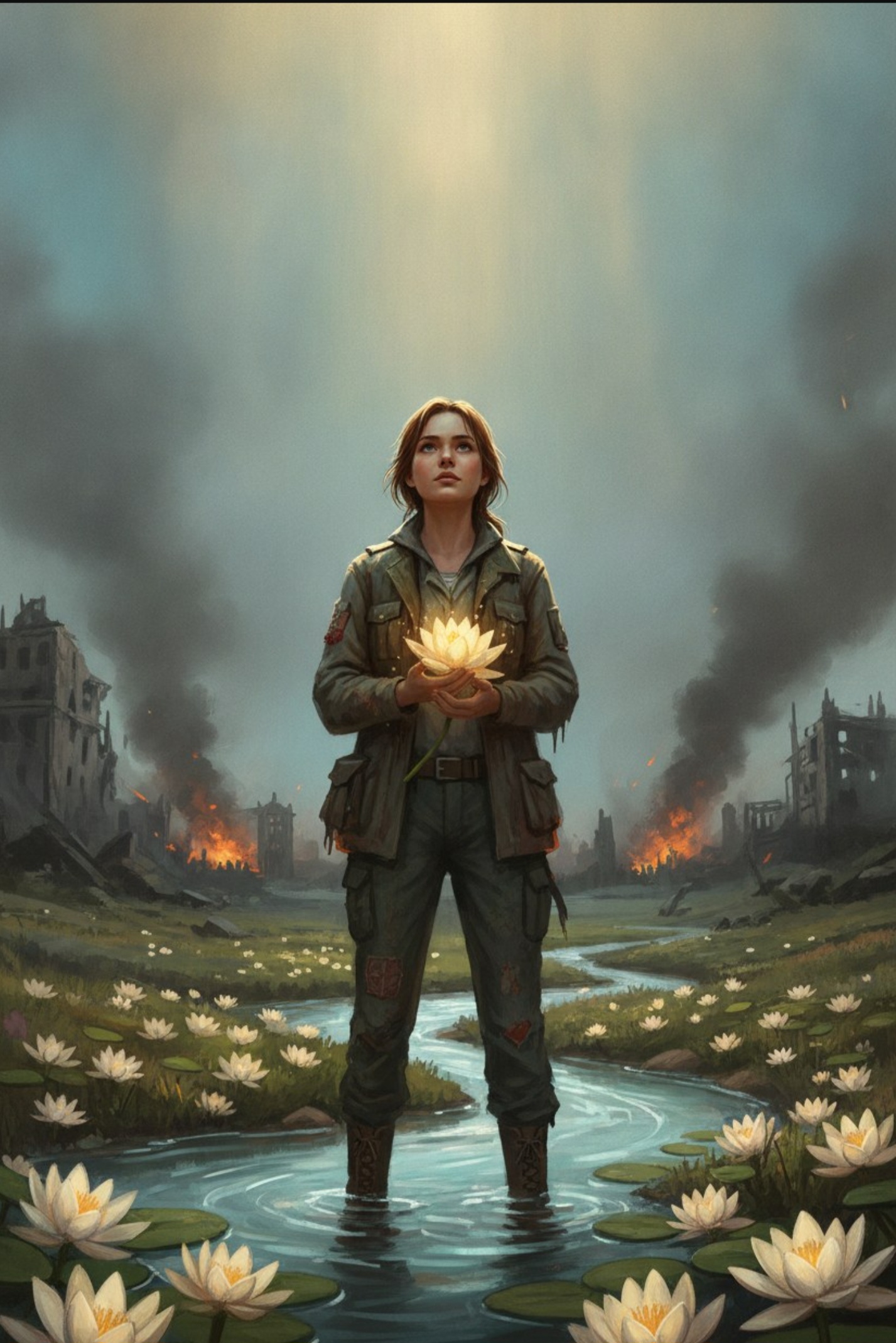
Coming to, she saw something strange. The dead were ascending a staircase that descended from the sky. Their silhouettes were indistinct. As if someone had drawn them with a trembling hand. A faint radiance emanated from them, like the light of distant stars. One of them, the man she had wheeled on the gurney, came up to her and asked whether she would go with them. His voice sounded not here but somewhere inside her head, like a memory that had suddenly become alive.
Dina asked, swallowing tears and trying to hold on to consciousness: "And where are you going?"
"We are going to the sky," the man answered. In his eyes there was neither pain nor regret—only calm certainty. The kind a person has when he has finally found the way home.
"Everyone who died in the explosion ascended it," he added, waving a hand toward the staircase. Its steps dissolved in the air without touching the floor.
But the girl did not want to go. In her chest, despite the pain and darkness, a stubborn little flame still glimmered. After all, she had not yet done everything. She had not yet said important words to someone. She had not yet seen the dawn paint the sky in colors she had never noticed before.
Then the man said she would have to go "by the fireflies." And at that same instant little glowing points began to tremble around her. They were not lights but tiny sparks of hope that did not go out even in the densest darkness. They circled as if alive, as though they knew where to lead.
When she finally came fully to herself, she was alone. Those glowing points really were fluttering nearby. Their light was so warm that even the pain retreated for a moment. Allowing her to draw one more breath. She stood, bracing herself on a fragment of wall, and followed them. Making her way out through the rubble of the half-ruined wall. Every step was hard, but she did not stop. Fear was no longer an enemy but a companion who whispered, “You won’t make it.” She answered it in silence, proving the opposite with every movement.
Outside, people were already bustling with that focused urgency that appears where every second counts. A command post had already been set up. Tents, floodlights, wires stretched taut like nerves. MChS and Rosgvardiya were clearing the rubble, leading out or carrying out the wounded and the dead. The rescuers’ faces were tired but determined. They knew: as long as they kept moving, hope was still alive. Who had survived and who had not—they were only just beginning to tally that account. The numbers did not yet mean anything, because behind each one stood a person whose name someone whispered, afraid to believe the worst.
With difficulty, gathering the last remnants of her strength, Dina only managed to whisper, “Help me.” That whisper was so quiet that even a raindrop could have drowned it out. But it was heard. Two medics ran over. Their faces twisted with horror for an instant, but they immediately hid it behind the usual mask of calm. They transferred Dina onto a stretcher and ran toward the vehicle. In that run there was not only haste but also a promise: “We won’t leave you.”
And then, already losing consciousness, she felt someone’s hand tightly squeeze her fingers. It was enough to keep the darkness from taking her completely. It gave her confidence that she was not alone.