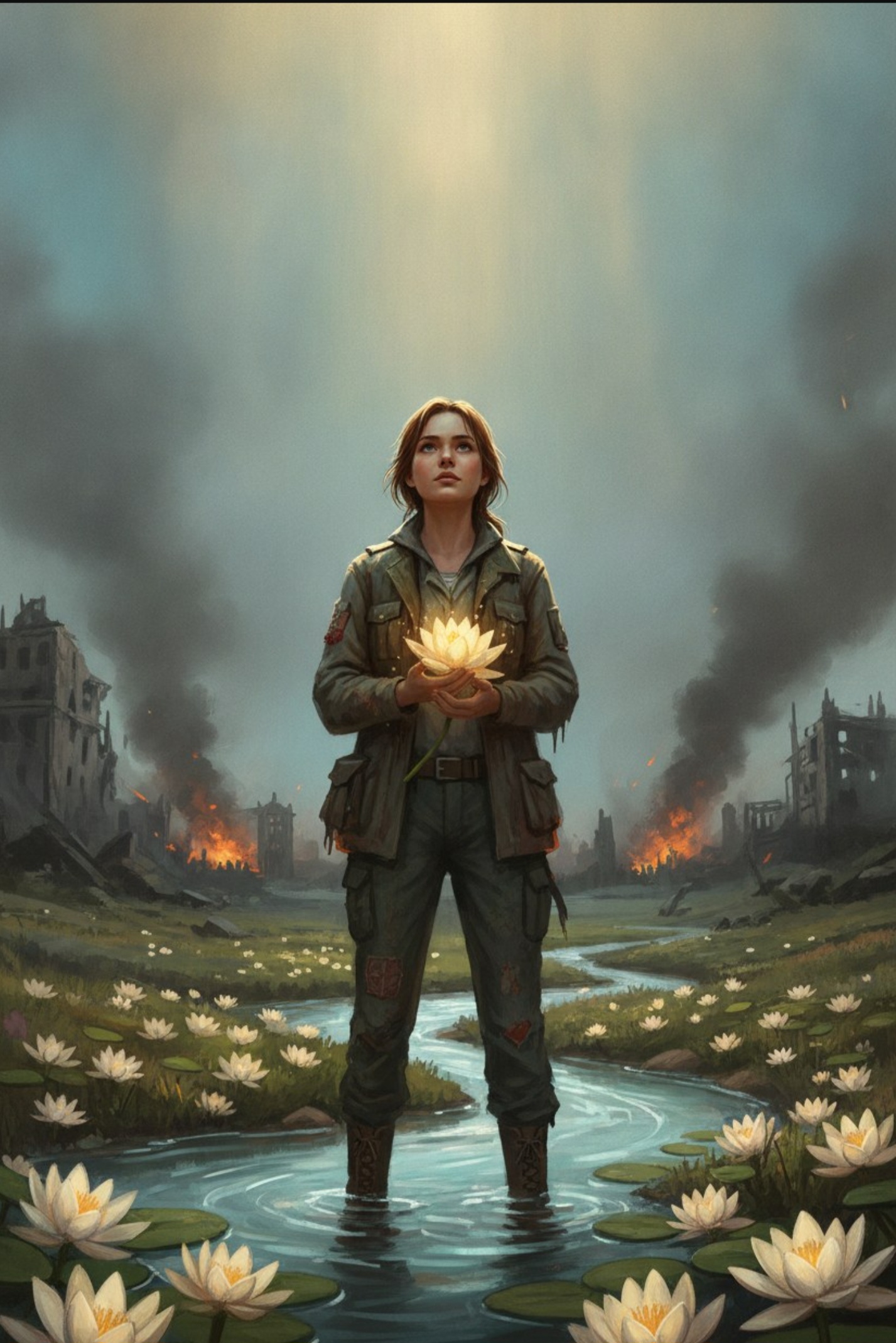
Life sometimes resembles a fairy tale, but sometimes it becomes a cruel reality, like Dina from Donbass. Her story is about resilience, strength of spirit, and love that do not fall apart even when the world around them cracks at the seams.
That evening Dina stood by the window, pressing an old plush fox to her chest—a gift from her father. The glass trembled from distant explosions, and a thin crack slowly crawled across the windowsill, as if the apartment itself were trying to tell what could no longer be spoken aloud. Only that morning she had laughed at her brother, who was afraid of thunderstorms, and now she could not bring herself to look at his empty bed: the silence in the room had become too heavy; it pressed on her chest and made it hard to breathe.
Dina knew that Mama would go off again to the night shift at the half-ruined medical station, and then the house would be left alone with darkness and fear. But she had promised herself that she would not cry in front of her brother if he woke up, and would not let fear creep into her voice. “We’ll manage,” she whispered, though the words scraped her throat as if they were made of glass. And in that whisper there was more pain than in tears: the pain of having to be an adult at thirteen; the pain of the fact that ordinary things—the smell of bread, laughter in the yard, the creak of the swings—had become a luxury that was now remembered in a whisper, so as not to frighten the memory away.
And then the telegram came. Short, dry, with alien official words that could not contain an entire life. Dina’s fingers went white as she clutched the paper, and suddenly all the happy days flashed before her eyes at once—as if reality had decided to blind her with light one last time, only to leave her in darkness afterward. She did not scream. She did not drop the letter. She simply sank slowly to the floor, holding the fox close, and whispered, “No. Not now. Please, not now…”
But it was precisely at that second, when the ground seemed to fall away from under her feet, that stubbornness awoke in her—quiet, prickly, like a steel string. The pain did not break her; it pulled her taut to the limit, and now that string rang inside her, reminding her: as long as she breathes, as long as she remembers the faces of those she loves, the fairy tale is not over. It had simply become a different one—a story where miracles are made by hand, and hope rests on a single promise: “We will definitely meet again.” And for the sake of that promise, Dina was ready to hold on to every dawn, even if the night tried to take everything. ...
Well then, dear reader, let us begin to live through this difficult story of her life with her, by reading it.