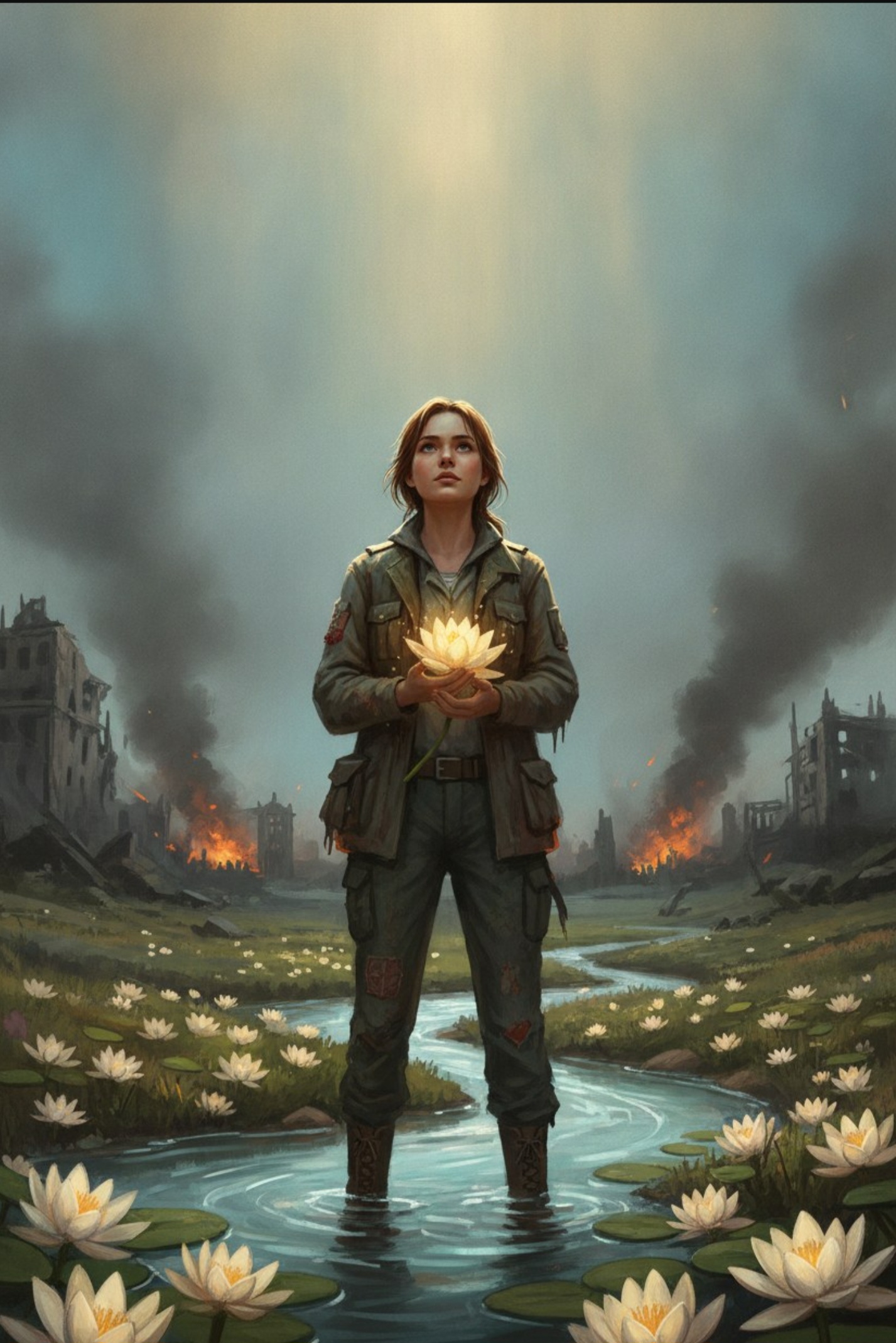
The peaceful sky over Donbass, and over the whole country, was covered with clouds of anxiety and suffering. Grief and loss entered every family. The call-up began. All the men went to the front. The city emptied; moving through the streets became difficult. Checkpoints everywhere, curfew.
Dina and her family also submitted to the new rules. Bread was not easy—deliveries were often interrupted. Every piece was guarded like treasure. In the house now there was no smell of fresh baking but of damp and cold. The radiators had long stopped heating. The windows were pasted over with strips of paper in a crisscross pattern so the glass wouldn't shatter from the blast wave. Every day they had to hide in the basement from shelling.
It was especially hard to see killer drones attack civilians. It recalled the times of the Great Patriotic War. As if history had decided to walk over the same scars. Only now death flew in not with the roar of airplanes but with a quiet buzzing. It made the blood freeze in one's veins. The main battle became an artillery duel. About 80–90% of clashes occurred because of artillery shelling. The one who could shoot better won. In combat, most often people received shrapnel wounds, not bullet wounds. This meant more people would die. It seemed someone was playing Battleship, firing at "squares" and never meeting the enemy face to face. Trenches had to be made so soldiers could take cover underground. The "god of war" was cunning and tried to kill as many people as possible, regardless of age or status.
All those liable for military service were called to the front. Anna, Dina's mother, a nurse, signed the mobilization papers. She was assigned to the medical unit of the city hospital. This became a real gift from fate for the family. Though Anna would be near pain and death every day, she would remain in the city. She could come home at least occasionally. Bring news, sometimes a little sugar or a can of stew from grateful wounded men. For Dina this meant she still had someone. Someone she could press close to when the earth shook from explosions.
Hard times temper people. Our heroes, despite the horrors and fear, retained their human form. Mercy, compassion, and love for their neighbors blossomed in their hearts. These qualities helped them not give up and continue fighting for the right to live.
Dina often raised her eyes to the sky in the evenings, when she managed to relax a little. She looked at the stars and wondered: is there anyone up there now? If so, why does he allow so much misfortune in their lives? When Dina was little, her grandmother was a believer. She told her a lot about God. About how even in the darkest night there is light. You just must not lose hope. But now Dina remembered almost nothing. Only fragments of phrases, the smell of incense. Her grandmother's quiet voice, which now sounded in her memory like a distant lullaby. Her grandmother had passed away early. No icons or prayer books remained in the house. Everything had disappeared somewhere, gotten lost among boxes and old things.
One evening, when Dina was sitting by the window, listening to the silence. It had become so suspicious that in itself it seemed a harbinger of trouble. The girl suddenly noticed how a drop of condensation slowly slid down the glass. She ran her finger over the glass, wiping away the moisture. She saw her own face flash in the reflection. Too grown-up for thirteen, with dark circles under her eyes and a crease between her brows. That hadn't been there before. At that moment she felt something tightening inside her. It was not just fear but a sharp, almost physical pain. The pain of childhood slipping through her fingers like water.
That same evening the familiar whistling sound came. Dina, without waiting for shouts and sirens, darted to the basement door. On the way she grabbed an old plush toy—a rabbit her grandmother had once knitted for her with her own hands. The rabbit was worn, with one button instead of an eye. Dina pressed it to her chest as if it could protect her from the whole world. The basement was cold and smelled of mold. People sat in silence, wrapped in blankets. In this silence one could hear someone's teeth chattering. Somewhere a child quietly sobbing. Dina closed her eyes and squeezed the toy tightly, repeating to herself the words her grandmother had once whispered: "Hold on, my good girl, hold on..."
Anna came home late. That night, when the city was especially shaken by explosions. She entered the apartment, leaving behind the smell of iodine, blood, and iron. Her hands were trembling, and in her eyes was frozen a weariness that could not be washed away. Dina rushed to her, buried herself in her coat, breathing in that strange but dear hospital smell. And she understood that now, in this second, she felt safe. At least for a few minutes. Anna hugged her daughter, pressed her close, and whispered: "We will endure, do you hear? We will certainly endure." And in that promise, fragile as glass though it was, there was so much strength that Dina believed.
The next morning the city woke under a gray sky. It seemed to have descended lower than usual. Almost touching the roofs of the houses. Dina went out into the yard to fetch water from the pump. The air was pierced with cold. The silence rang so loudly that her ears buzzed. On the corner of the house someone had written in chalk: "We're waiting for you at home." Dina stopped, looking at these simple words. She felt a lump rise in her throat. She knew these words were not addressed to her, but they still burned her heart. At that moment she understood that hope does not live in loud promises. But in little things like that, like the inscription on the wall, in her mother's warm gaze. In the way someone shares the last piece of bread.
And though the sky remained covered with clouds. The city—emptied and wary—in people's hearts a light still glimmered. It was quiet, almost imperceptible, but it was there. And that was enough to take one more step forward.