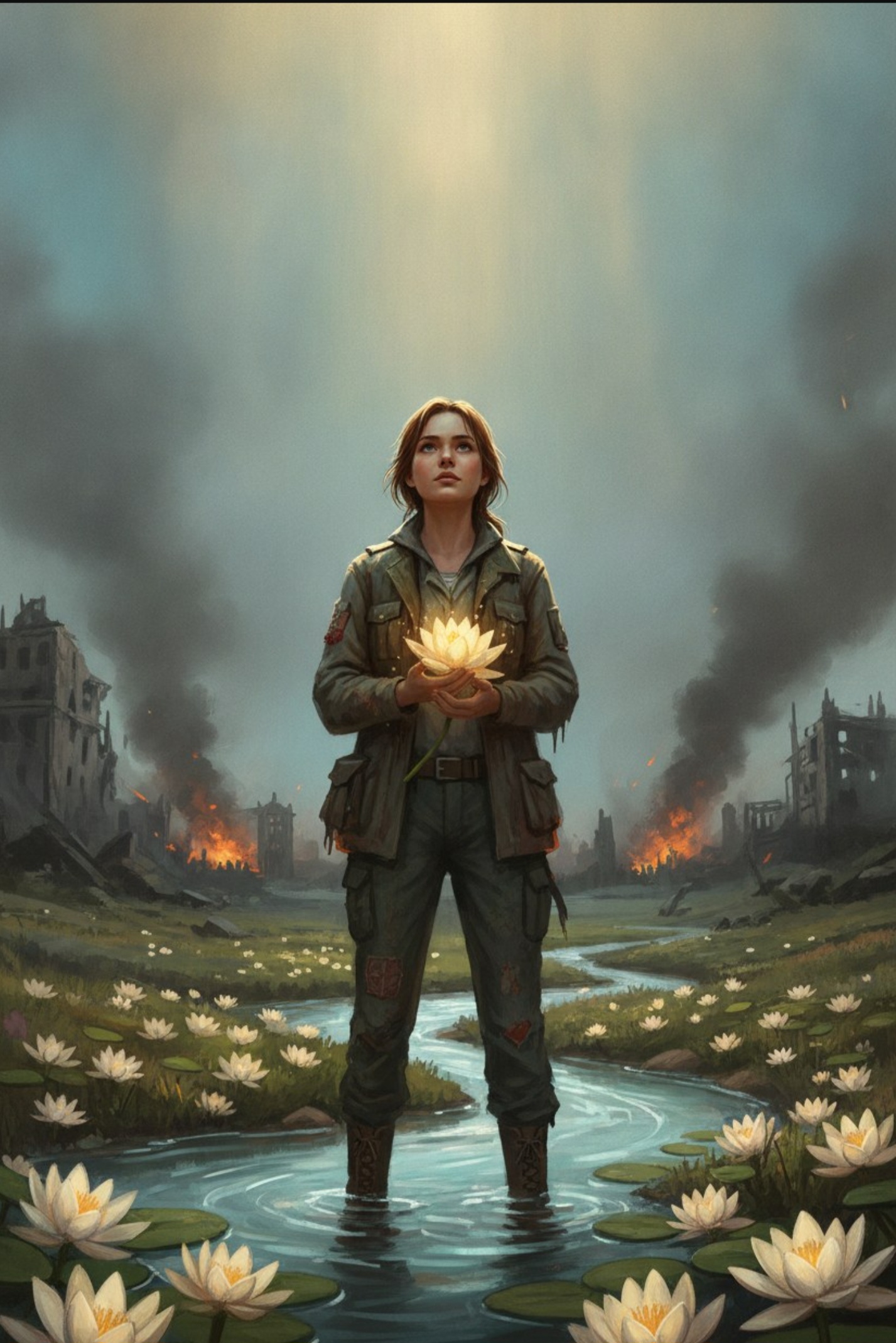
Coming out onto the road leading to the central street of the settlement, they immediately felt that the silence here had become different. Heavy, as if soaked through with fear. Every step echoed in their chest not merely as the echo of footsteps but as the reverberation of what had already happened. And in that ringing emptiness a woman suddenly appeared. She was coming from the shop, clutching a paper bag to herself.
“Aunt Masha… Hello,” Misha said quietly. His voice faltered like that of someone who had been silent for a long time and now feared the words wouldn’t come out. “How are you? How’s our street? I was told our house was badly damaged… So we’re going to see what’s left of it at all. Meet Dina and Anna, my new family. They took me from the hospital to live with them.”
Mama nodded and offered her hand. There was so much caution in that gesture. Maybe she was afraid that any abrupt movement might break something for good? Who knows.
“Hello, Maria.”
Dina also returned the greeting. In her “hello” one could hear not just a polite word but an attempt to keep her balance.
The woman smiled sadly, but the smile immediately crumbled before it could become real. She looked at Misha. And she saw in him not just a boy but everything that could have been good in this settlement, and now she was afraid to believe that this good still existed.
“How glad I am to see you…” she said to the boy. Her voice cracked like an old board under the weight of snow. “After that shelling… Of course, many on the street were hurt. Some more, some less. Your house half collapsed, the roof couldn’t hold, but you can get inside… I called that hospital where you were taken. I know everything. Thank God you pulled through…”
And then she couldn’t hold it in: tears poured out in a stream she had held inside all these days. She came over and hugged Misha. Pressed him to herself tightly, desperately, the way people press close what they nearly lost forever.
“Forgive me, please… Everything turned out so bad. In one moment so many tragic fates appeared… Who would have known… We probably should have gotten away from trouble while we could… The head of the village council promised to restore everything soon. The shop started working again recently, the pharmacy… And little by little we’re coming back to ourselves… Why are we standing here, come to my place, let me at least feed you… You must be hungry and cold from the road…”
Of course, they didn’t object. The weather was hardly May. The wind clutched at their clothes. It crept under their jackets as if trying to remind them that warmth here was now a rarity. After walking a little down the street, they stopped at a gate.
It was worn, with cracks in the boards. The paint had peeled and gave it a neglected look. Which couldn’t be said of the front garden beside it. There were flowerbeds everywhere, flowers planted thickly; many had already shed their petals, but some still remained untouched by wind and cold. Neat and tidy. You could see the owner was trying with all her might to hold on to at least a small piece of normal life.
You could hear a cow mooing and pigs grunting. Chickens clucked in different voices. Catching the last withered grass with their beaks and searching for worms beneath it.
“I see you’ve got a whole zoo here,” Dina smiled. True, the smile came out not cheerful but somehow fragile, like thin ice about to crack. “Even though we lived in a small town, we never had anything like this, just a little vegetable garden. How interesting…”
And she ran up to the wire netting with the birds. Emotionally she wanted to hide for at least a minute in this simple, living noise. But to Misha all this was, on the contrary, familiar. They had had a small farm themselves. Only now it made no difference to him. Everything seemed alien, as if he had returned to a house where he no longer lived.
The woman said:
“Yes, God feeds us with this. The garden and the farm. If not for them, we’d be hungry. The shop works off and on. If you need something big, you have to go to the neighboring town…”
The wooden house, one-story, old, was exactly like houses that had survived too much. A traditional Russian log hut, a five-walled izba. Even the shutters had survived. The paint had peeled, but it still looked good. That happens—something looks good because it has stood firm despite everything. The roof was gabled, rusted with time. On the newly added veranda sat a ginger cat, eyes half-closed, purring.
Misha went over, stroked the cat, scratched behind its ear, and said quietly:
“Well, hello, bandit… Did you miss me? Now you see, I’ve come to visit you…”
In that “visit” there was something bitter. After all, he understood himself that all this was no longer his. That he had come here as into the past, to which one cannot return.
The woman invited them all inside.
Inside, the house had no excess. But it had that very heartfelt warmth that you cannot buy or build. It appears only where people day after day try not to let each other freeze. In the small living room stood an old wooden sofa covered with a checkered blanket. A couple of armchairs with worn upholstery. By the window—a massive dark-wood table and benches instead of chairs. On the walls—several black-and-white photographs in simple frames. An antique clock with a pendulum, steadily counting off the seconds. They reminded that life goes on even when it seems everything is over. The kitchen was modest. A white cupboard, enamelware on the shelves. On the windowsill several pots with herbs. In the bedroom—a wide bed with linen bedding and a small dresser against the wall. Everything was functional, homely simple and genuinely calm. The kind of calm there is on a little island that miraculously wasn’t washed away by the wave.
After taking off their coats and washing their hands, they sat down at the table.
The hostess brought reheated fried potatoes with cracklings from lard, little cucumbers, little tomatoes, and a carafe of compote. She cut the bread unusually thick for them. And kept saying: eat, don’t be shy. In every word could be heard an attempt to hold on to this evening, to make it real, so that at least for an hour they could forget that outside the world was falling apart:
“A big piece makes the mouth happy—eat, eat. Anyone want more, don’t be shy…”
Of course, no one asked for more. It was tasty and very filling. Food at that moment wasn’t about hunger. It was about someone caring for you when it seemed there was no one left to care.
Then there was tea and conversation. Not loud, not cheerful, but the kind that happens when people carefully share what hurts, afraid of spilling that pain around the room.
Glancing at the clock hanging on the wall, Anna said quietly:
“Our bus back is at six in the evening. We need to make it before dark to see what’s going on with Misha’s house… Thank you so much. God grant you health. You’re wonderful, you’ve given us so much of your attention… Let’s exchange addresses and phone numbers. Of course, right now there’s almost no connection, but letters can be sent the old-fashioned way…”
They exchanged details, writing down addresses and numbers with fingers trembling from emotion. It looked as if these lines could become a thread that would keep them from getting lost in this vast world that had suddenly become alien.
As they were saying goodbye, Misha paused for a second at the threshold, turned around, and whispered quietly:
“Thank you, Aunt Masha… I’ll write…”
And Maria, pressing her hands to her chest, drew a deep breath. In that breath there was so much relief and so much pain that it seemed she had exhaled all the fear she had been accumulating over these days. She was very glad that the boy had ended up in good hands. But at the same time she understood that he was leaving, and part of her small, fragile world was leaving with him. And all that was left for her was to stand at the gate and watch them go until they disappeared around the bend, and whisper to herself: “Let everything be all right for them. Please.”
←
The Girl from Donbass
Chapter 17 · 17 of 18
Chapter 17
~5 min