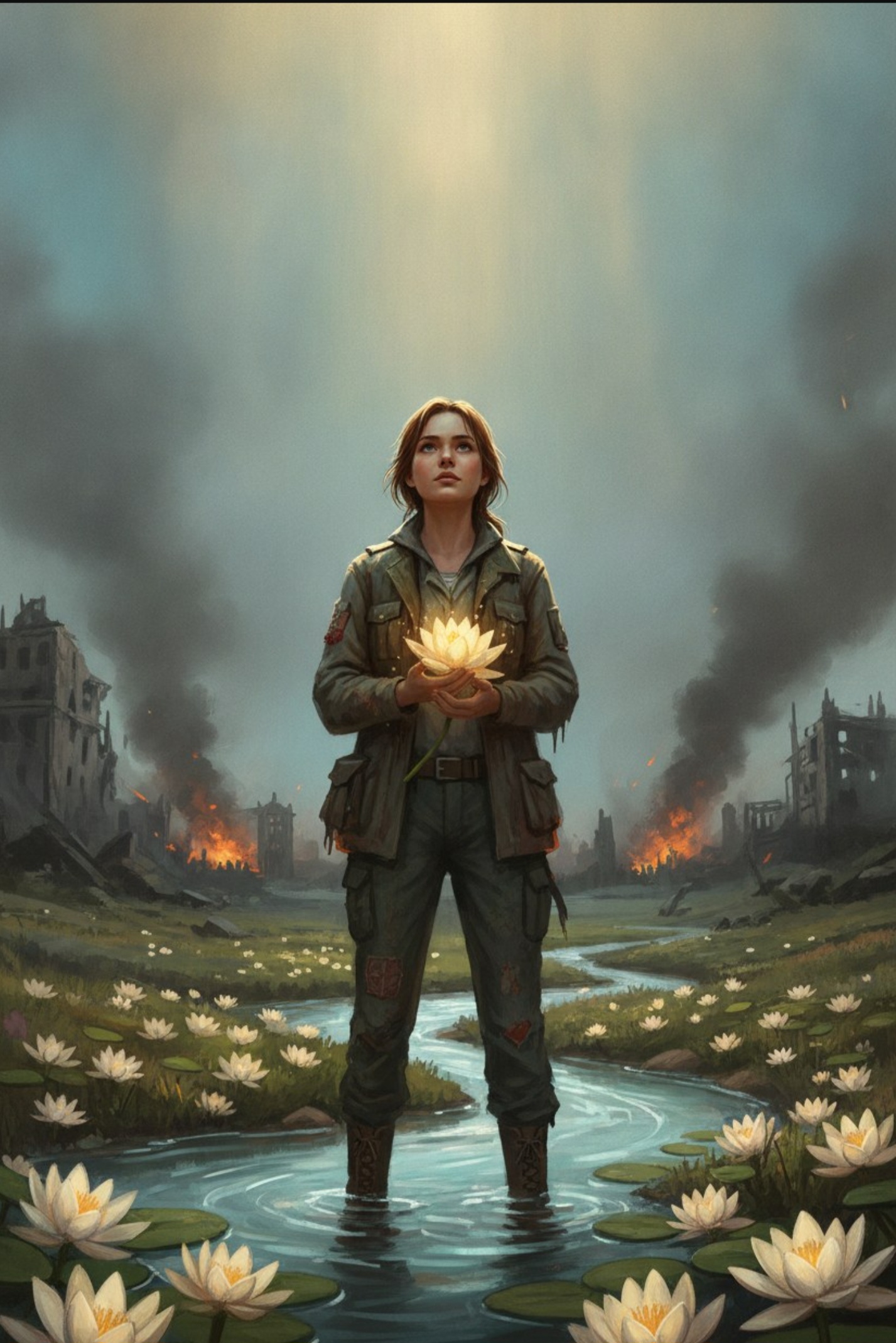
The girl herself was still recovering. The room smelled of iodine and old wood. The doctors said there would be “echoes” for six months. Shortness of breath. Discomfort. The pain troubled her—not constant, but still there. It felt as if someone periodically squeezed her ribs. Sometimes dull, sometimes sharp, like that very shrapnel fragment. But what was that compared to what she had now? To the way he had said, pressing her to himself: “Now you have a brother.” Not “friend.” Brother.
She ran her thumb over her palm—the imprint was still there. She so wanted everything to work out for everyone. For that pain not to return. For them simply to live.
She sat down at the writing desk. The pencil trembled. The line came out crooked: “Today I am truly not alone. And that is enough.” She reread it. She wanted to add “for all of us,” but her hand trembled again. She closed the diary. Carefully. As if it were a sacred thing.
And then she picked up the Psalter.
The shrapnel had pierced the cover in the middle. Now it was not merely a hole—it was a wound. Gaping. With torn, seemingly scorched edges. The lamplight pushed through it. She turned the pages. This part had been beautiful, and here was the edge beyond which there was no more text. “It’s a pity you can’t read all of it now.” She ran her finger along the edge of the hole. The cold edge of paper. The cold edge of metal. “But I will never dare throw it away. Even if my hands tremble. Even if it hurts to hold it. This book will stay with me for the rest of my life.”
And she also wanted to visit Aunt Olya. Maybe she had another one like it. Another whole one. They hadn’t seen each other for a long time. The connection had almost disappeared. She tried dialing the number—there was only white noise in the receiver. Like a scream into the void. “What if she has one there too? And what if she is also turning its pages by candlelight right now?” The girl exhaled. It was better than nothing.
And somewhere out there, in her native city, the silence was special. Not peaceful. Deadened. Wary. It pressed harder than the roar of shelling. But it did not drown it out; it turned every distant bang into a blow against her temples.
The streets, once noisy and crowded, were empty. Shop windows gaped with black holes. The glass was broken; inside there was only darkness and dust that smelled of damp. Signs hung on one hinge, askew like dead birds. The wind chased scraps of newspaper along the asphalt. White patches that immediately merged with the mud. Dry leaves like ash. On the wall of a surviving house, someone had written in charcoal: “We will return.” It was not just an inscription. It was an oath. Torn, like that wall: the first letter broke off halfway.
Four years ago children had laughed here. Trams had clanged. Cafes had smelled of freshly brewed coffee—hot, slightly bitter, with foam. Now, instead of a cafe, there was a pile of stones. Instead of smell—dust and scorched concrete. Instead of laughter—a creak. A sign swayed by the wind knocked against a metal frame: knock-knock-knock. Like a metronome. Like a count.
The square where an orchestra had played on weekends was overgrown with weeds. Their stalks rustled underfoot. Persistent shoots pushed through cracks in the asphalt. But they were not flowers—they were hard gray grass. The earth really was trying to heal its wounds. And in the most unexpected places, details survived. A porcelain doll’s head in the dust—with one eye, without a smile. Half a photograph on a fence. A boy in a cap and a woman in a headscarf. The name on the back had been erased. Only a shadow remained. Two halves. Like so much else.
Many abandoned houses. Half-ruined. With smashed windows. And amid all this, like the last candles in a dark house, a muted light. There was Olga’s window. Warm. Yellow. It lit the path in front of the house, as if showing the way to someone who had long since forgotten where to go.
After everything that had happened, after the medical unit, after those people, after Dina—it became harder for her to breathe. The stress had had its effect. That strange shortness of breath had appeared. The air did not reach her lungs. It seemed someone had pulled a ribbon tight around her chest. Her legs had swollen. The shoes that had fit a week ago now pinched so much that every step was like stepping on glass. She took them off and immediately saw her toes. Red, with blue veins.
“What can you do,” she thought. “I’m old already. In a week I’ll be seventy-five. And it’s sad. That my supports—my son Vasenka and my husband Kolenka—went into the damp earth before their time. And now I’m alone. Only God. And that is my support.”
There was a cold scraping in her chest. Treacherous. It pulled downward, toward the floor, toward darkness, toward the wish never to get up again. She clenched her fists. Not now. Not here.
And she opened the Psalter.
Her eyes fell on the line:
“The Lord is my light and my salvation: whom shall I fear? The Lord is the strength of my life: of whom shall I be afraid? If evildoers, my opponents and enemies, advance against me to devour my flesh, they themselves will stumble and fall. If an army encamps against me, my heart will not fear; if war rises against me, even then I will hope…”
And beyond that—emptiness. An ellipsis. Like a break in the line.
She finished reading in a whisper. That “even then I will hope…” sounded like the last line before the edge.
“Lord… let this be enough,” she said. She wiped her eyes. A wet handkerchief. The smell of dust. She did not know whether she would ever finish that chapter. But those words were here. Heavy. Constant. Indestructible. Like this book. Like that window.
She turned off the light. The room sank into darkness. Only the window opposite—someone else’s, warm—was still glowing.
“If only I could meet Dina and Anna. The Lord will see to it. Himself.”
She did not know when that would happen. Maybe in a year. Maybe never. But for now it was the only prayer she could utter. Without promises. Just—aloud.
Two dark rooms. Two books with torn holes. One hope.
←
The Girl from Donbass
Chapter 14 · 14 of 18
Chapter 14
~4 min