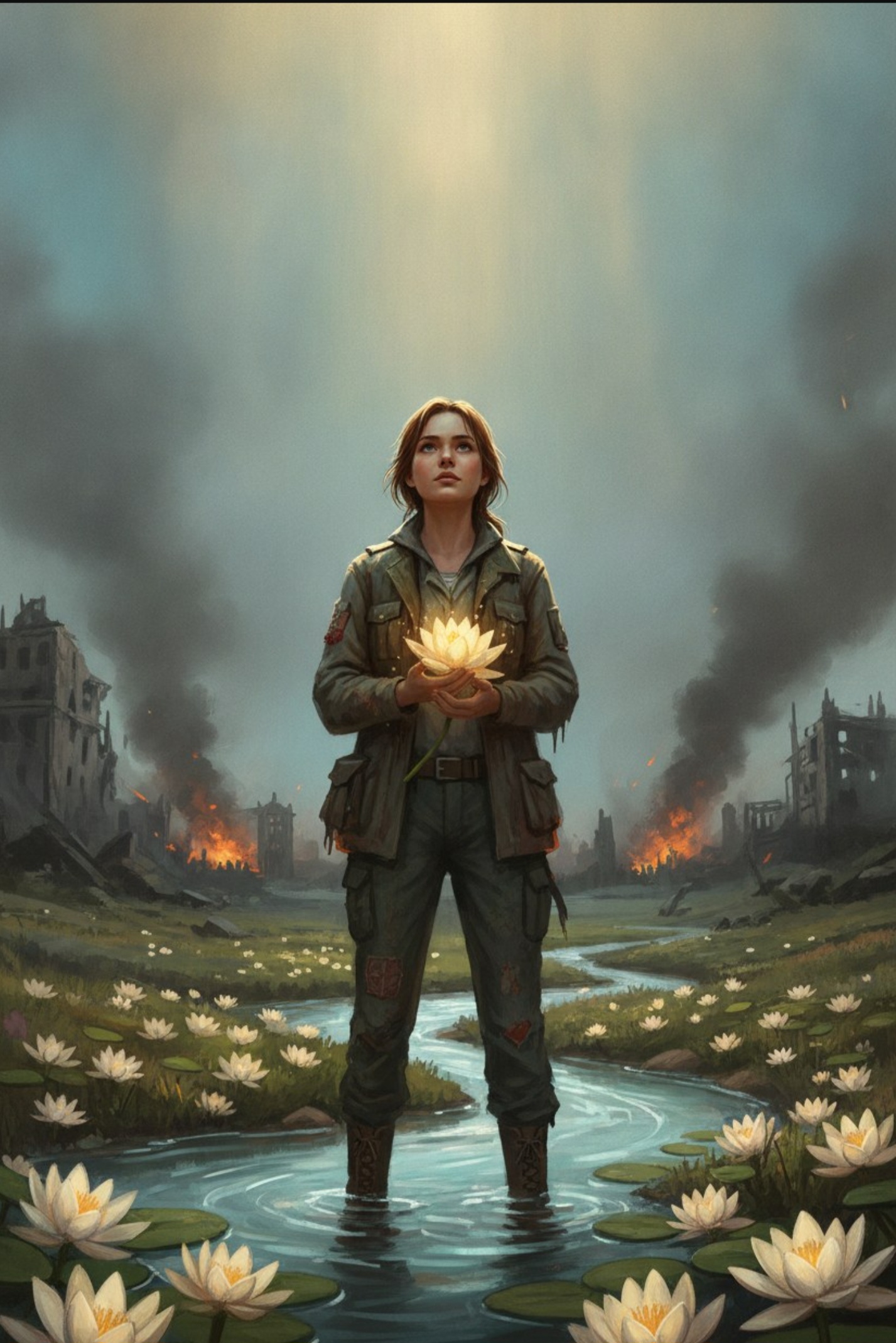
Spring itself was trying to prove that life was stronger than the silence that had taken root in the city. Nature came alive—but its joy seemed too loud, almost defiant against the backdrop of empty streets. The snow had melted, turning into ringing streams that ran along the asphalt. They were probably hurrying to carry winter away with them, and with it the heavy memories. Drips fell from the roofs, counting seconds like a nervous metronome. The trees were covered with swollen buds, from which the first sticky little leaves soon appeared. They smelled so sharp and fresh that the scent scratched from inside. Reminding her of childhood, when spring was simply spring, and not a respite between disasters. Birdsong began to sound in the air—and that carefree music made it almost painful. The world kept living even when it seemed it ought to freeze.
The residents of Donetsk caught these smells. The aroma of meltwater, fresh greenery, swollen buds. Of the first flowers, like a gulp of air after a long dive. They smiled at these little things. They were afraid that if they didn’t smile now, spring would disappear. And the city would remain forever in a gray half-dark. Dina, a student at Donetsk Medical College, was preparing for exams. But cramming could not drown out the hum of thoughts. She was a capable student. All year she had studied with top marks, but now grades seemed something distant, almost toy-like. Like medals for winning a game whose rules had suddenly changed. Before the exams she managed to return to her mother for a short time. Beside the only close person she had left, Dina felt especially good. But not because fear disappeared, but because it became easier to hold it together when there were two of you. She needed her mother’s words and embraces. As an anchor, so as not to slip into that emptiness where you can’t even hear the drips from the roof.
The city had emptied and seemed orphaned. It was like a house everyone had moved out of, leaving only old photographs and the smell of dust. Dina remembered childhood, when she and her brother had had many friends. They raced around all day doing their own thing, were friends and argued. They built huts out of cardboard boxes and swore they would never move away from each other. But how good it was that this had happened. Because the memory of those days now warmed like a warm scarf in the frost. Now almost everyone had left. Only old people, those liable for military service, remained. Those who had nowhere to go, and, of course, the dead. Many of her friends and comrades had died in the first years of the conflict. This silence, in which their voices did not sound, was the heaviest. Sometimes Dina thought she heard their laughter in gusts of wind. Then her heart clenched so hard that it became difficult to breathe.
It was time to leave. Tomorrow was the first exam. Dina said goodbye to her mother. In that farewell there was so much unspoken that words seemed superfluous. Her mother simply held her tight. She wanted to put into that embrace all the strength her daughter would need ahead. Then she said quietly: “Come back. Be sure to come back.” And Dina nodded, although inside everything was screaming with the fear that “come back” might become the hardest word in her life.
In the morning the practical placement lists were posted. Beside each surname a city or district was indicated. To her joy and her mother’s pride, Dina was sent to the medical unit of her hometown. How nice. We’ll spend the whole summer together, Dina thought. There was so much light in that thought that for a moment even the sky seemed brighter. Having passed her exams, received her assignment and quickly packed her things, she set off home. Feeling relief and anxiety mixing inside her. It seemed she was running toward something important, but she did not know whether it would be salvation or new pain.
On arrival, before she had time to unpack, Dina ran to her mother’s work. After submitting all the referral forms, she filled out the documents and learned the duty schedule. She ended up as an orderly in a battalion medical unit. In a team that brought soldiers back from the front. There was a lot of work. Sometimes departures happened every day, then a lull set in. Then another intense period began. The work was like the city’s breathing, which either froze or broke into a heavy, hoarse inhale. Everything depended on the intensity of combat operations in a particular sector. That unpredictability exhausted her even more than the work itself.
The evacuation group worked according to a set algorithm. Clear, calculated steps, where any mistake could cost a life. They went into the “yellow zone.” The place where transport could reach with certain restrictions. On site, the medics gave the wounded man first aid, then quickly loaded him and evacuated him to the rear. Everything was scheduled to the second. But reality always made its own adjustments. There were cases when they had to literally jump out of the car. And pull out a wounded man under a barrage of sounds that Dina tried not to name even to herself. Not to give them a name meant not to give them power. It was hard—not only physically, but also because every time she had to learn anew not to feel. In order to have time to do what was needed. Over time, her actions became automatic, and everything was carried out in emergency-response mode. But in the quietest minutes, when the car raced back, Dina caught herself trembling with a fine tremor that no one noticed.
Dina’s city was the “yellow zone,” the closest to the border. That meant trouble was always somewhere nearby, around the corner. Beyond the next block, beyond the next minute of silence. So this time, in the evening, they went out to collect the wounded. Everything as usual, nothing foreshadowed difficulties. And it was precisely that ordinariness that frightened her most. The car rolled softly along the broken road, headlights snatching pieces of reality out of the darkness. A crooked fence, an abandoned bicycle, the shadow of a cat darting aside. The radio crackled, transmitting short, dry phrases—coordinates, numbers, condition. Dina sat with her fingers gripping the edge of the seat and listened to that rhythm of strangers’ voices, trying to hold inside herself the cold clarity that was needed for work.
“We’ve arrived,” the driver said curtly, and the car stopped.
Dina got out first, and the air hit her in the face—damp, heavy, soaked with the smell of earth, iron, and something else she did not want to recognize. In the “yellow zone,” silence was special—not peaceful but wary, as before a storm. Somewhere far off a muffled rumble rolled, and the ground shuddered almost imperceptibly.
“This way,” the paramedic shouted, waving toward the half-ruined building.
They ran, ducking as if that could protect them. Inside it smelled of dust and blood—a smell Dina had already learned to distinguish among others, like a bitter note in a melody. The wounded man lay by the wall—a young guy, almost a boy, with a pale face and clenched teeth. He was trying to say something, but the words were lost in his hoarse breathing.
“Hold on, do you hear me? Hold on,” Dina repeated, applying the tourniquet, feeling her own fingers trembling but trying not to let that trembling pass to him. “We’ll get you out.”
Time stretched, turning into a viscous, sticky substance where every second weighed a ton. They quickly but carefully transferred the guy onto the stretcher, and at the moment the car door slammed shut, the ground shuddered again—closer, sharper.
“Let’s go!” the driver shouted, and the engine howled, tearing off.
The car lurched forward, bouncing over potholes, and Dina held on to the stretcher, trying to keep it from swaying. The guy moaned softly, and the sound cut into her ears like an alarm. Outside the window shadows of houses, streetlights, debris flashed by—everything merged into one endless strip with no beginning and no end, only forward motion.
And when they finally entered a calmer district, where even the air seemed cleaner, Dina realized she was crying. Not from relief, but because this night had taken from her a little more of her childhood. A little more naivety, a little more faith that everything would be all right. But she wiped her tears with her sleeve and walked after the stretcher—because the work was not yet finished, which meant she could not stop.