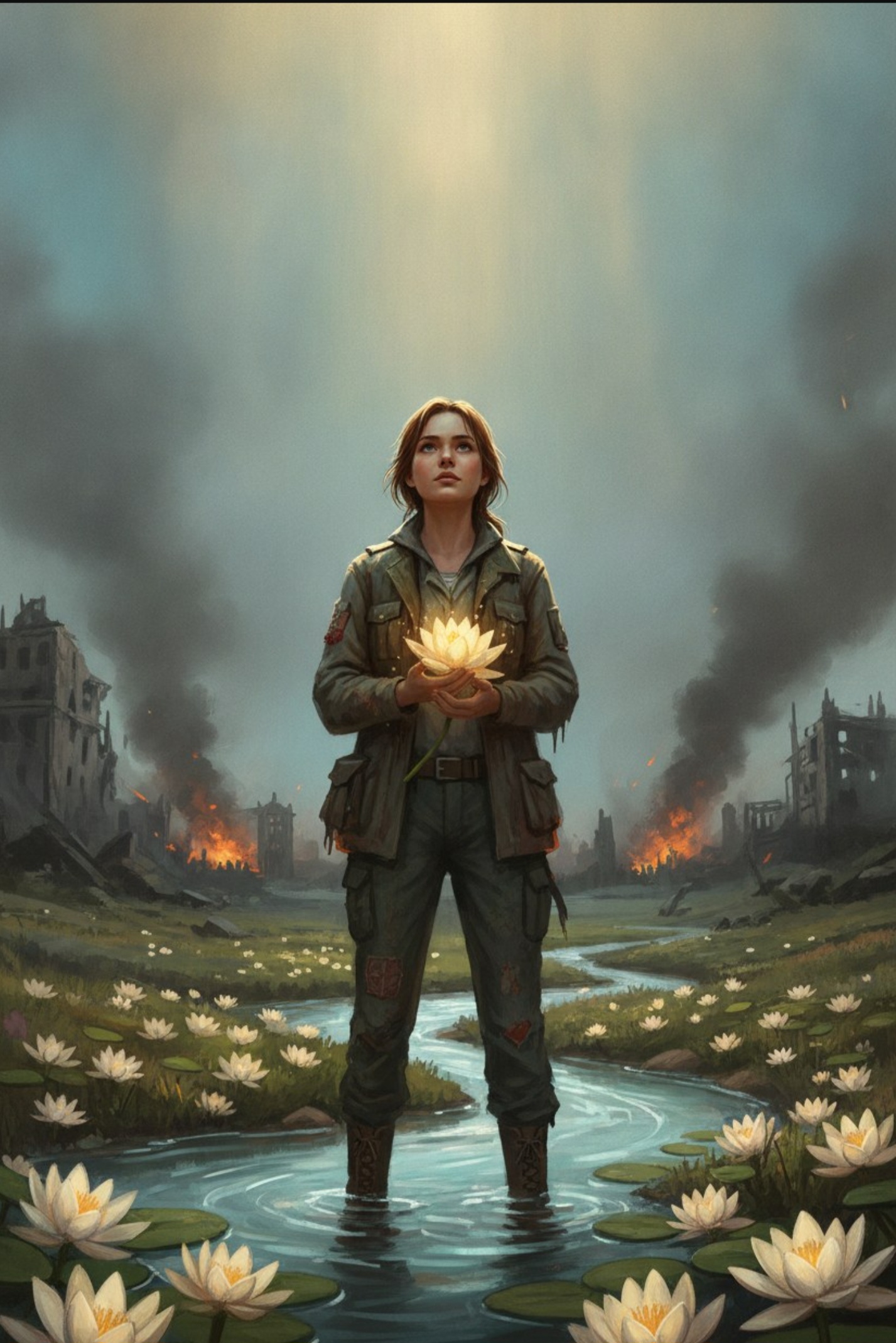
Well, here we are on duty again. A heavy, sticky evening was settling over the earth. The very air had grown thicker with tension. Today she was on a twenty-four-hour shift. Dina was a little worried, and not simply because of the responsibility. She was worried about the way that responsibility pressed on her chest like a concrete slab. The work wasn’t just dangerous. Every time it seemed to test how much courage you had left in you and how much was fear.
A signal came to the post: they needed to collect a seriously wounded man, and from the “red” zone at that. That meant a drive of some three hundred kilometers. And not at a convenient time, but at exactly six in the evening—when the shadow from the horizon crawls across the roads. Any delay could cost a life. The experienced driver Ivan Ivanych, call sign “Driver,” was at the wheel as usual. Calm, as if carved from stone. The medic Vasily Petrovich, “Pyotr,” silently checked the medical kit. And Dina stood by the hatch in the roof of the UAZ van, feeling the cold metal burn her fingers. That hatch was her post, her observation point. Her cage, from which there was no escape, even if she wanted to very badly.
They heard the first shots about a hundred kilometers out. At first, rare, like dry clicks. Then more and more often, as if someone were tearing the sky into pieces. The noise of vehicles rolled in waves. With every kilometer the silence became more fragile, ready to shatter at one extra sound.
But that was only the beginning. The hardest part lay ahead. The sky was not exactly clean. It was gray, ragged, shot through with tracer lines and smoke. It seemed the earth itself was groaning under the tracks. But they made it. They got there in time. They loaded the wounded man. He was unconscious, his breathing rare and uneven, like that of a man who had already said goodbye to life. Three drone operators asked to ride along. So tired, with eyes in which emptiness had frozen. There was no time to wait for an “air clearance.” Every second stretched like eternity and slipped through their fingers. They raced back.
The driver seated the wounded man beside him. It was easier that way to keep an eye on his breathing. The rest sat in the back. Dina again stood at the hatch. Clutching its edges until her knuckles went white. She looked ahead, as if by sheer will she could drive trouble away.
And trouble was not long in coming.
An FPV drone slammed into the roof of the vehicle. The sound was as if the sky had cracked in half. The metal groaned, fragments sprayed in all directions like angry sparks. To one wounded man were added others. The vehicle choked on a screech, like a living creature whose throat had been cut. The fragments tore the accelerator pedal cable and punctured the radiator. The same fragment that pierced the radiator cut up Ivan Ivanych’s leg. Blood ran down his boot, dark and thick. The medic and the trainee cut themselves on the glass. Small but vicious cuts that stung the skin and made you want to scream, but screaming was not allowed.
They gave first aid right there, in the shaking vehicle. Amid the smell of burning, iron, and blood. No one said unnecessary words. There was no time for that. Everyone understood: delay was a sentence. They had to keep going. And then Ivan Ivanych made a decision that made everything inside Dina tighten into a hard knot.
He opened the hood and reached the throttle valve. With his right hand he engaged a gear and began revving through the throttle, while with his left he steered. Every movement came with difficulty; his hand throbbed. It was as if nails were being driven into it, but he did not stop. The vehicle crawled forward like a wounded animal. Clinging to the road with its last strength. Dina looked at him and could not understand: how could this man have so much endurance? How could he so calmly do the impossible?
In the end they reached the “yellow zone.” No, they didn’t arrive—they crawled there, clawing those kilometers back from fate.
Already at the aid station, when both Ivan Ivanych and Dina were sitting and waiting for their wounds to be stitched up, the driver, with a slight smile, said:
“Congratulations on your baptism of fire, daughter. We all got a proper fright, but God’s mercy saved us this time.”
Dina raised her eyes. There were tears in them, but she did not let them fall. She looked attentively at the man, trying to make out in his words the truth she was so afraid to hear.
“Are you a believer, then?” Her voice faltered, and she heard it herself. “How do you know it was God’s mercy? Maybe it was just an accident…”
Ivan Ivanych twirled his gray mustache and narrowed his eyes. Something flickered in his gaze that made Dina shrink.
“I’ve seen a lot in my time, little one. More than you’ll see in your whole life. And I know what I’m talking about. I’ll say it for certain: yes. And more than that—if it weren’t for God, you and I would be lying side by side in the damp earth. In a crater, under the rain, and no one would even know where we were.”
The words struck her right in the heart. Dina lowered her eyes. The tears did roll down her cheeks after all. Something pricked inside her. As if a little needle had been stuck into her most vulnerable place. A thought flashed through her head: “So God really does exist. And everything that happened to us today is not an accident. It is mercy. Heavy, bitter, but mercy.”
Later Ivan Ivanych was awarded two state decorations—the Medal for the Salvation of the Perishing and the Medal of Luke of Crimea—as well as three departmental medals. But for him these medals were not the main thing. The main thing was the letters from the people he had saved. Thank-yous that he kept in an old tin box. And constant contact with those whose lives had been preserved. For example, with “Vorobey,” a drone operator who had once helped the medics find a convenient base point and later ended up on the brink himself. Now they called each other once a week, talking about nothing and everything at once. “Not a simple partner,” Ivan Ivanych thought. And there was a bitter truth in that. In war, simple partners don’t survive.
And Dina… After that run Dina could not fall asleep for a long time. She dreamed of shots, the screech of metal, the eyes of the wounded man who never regained consciousness. And Ivan Ivanych’s words, which now sounded in her head like a prayer. She did not know whether she believed in God. But she knew one thing for certain: that day they should not have survived. And the fact that they did survive was not simply luck. It was something more. Something that cannot be explained by formulas and the laws of physics. Something that stays with you when the whole world is collapsing and you still take a step forward.