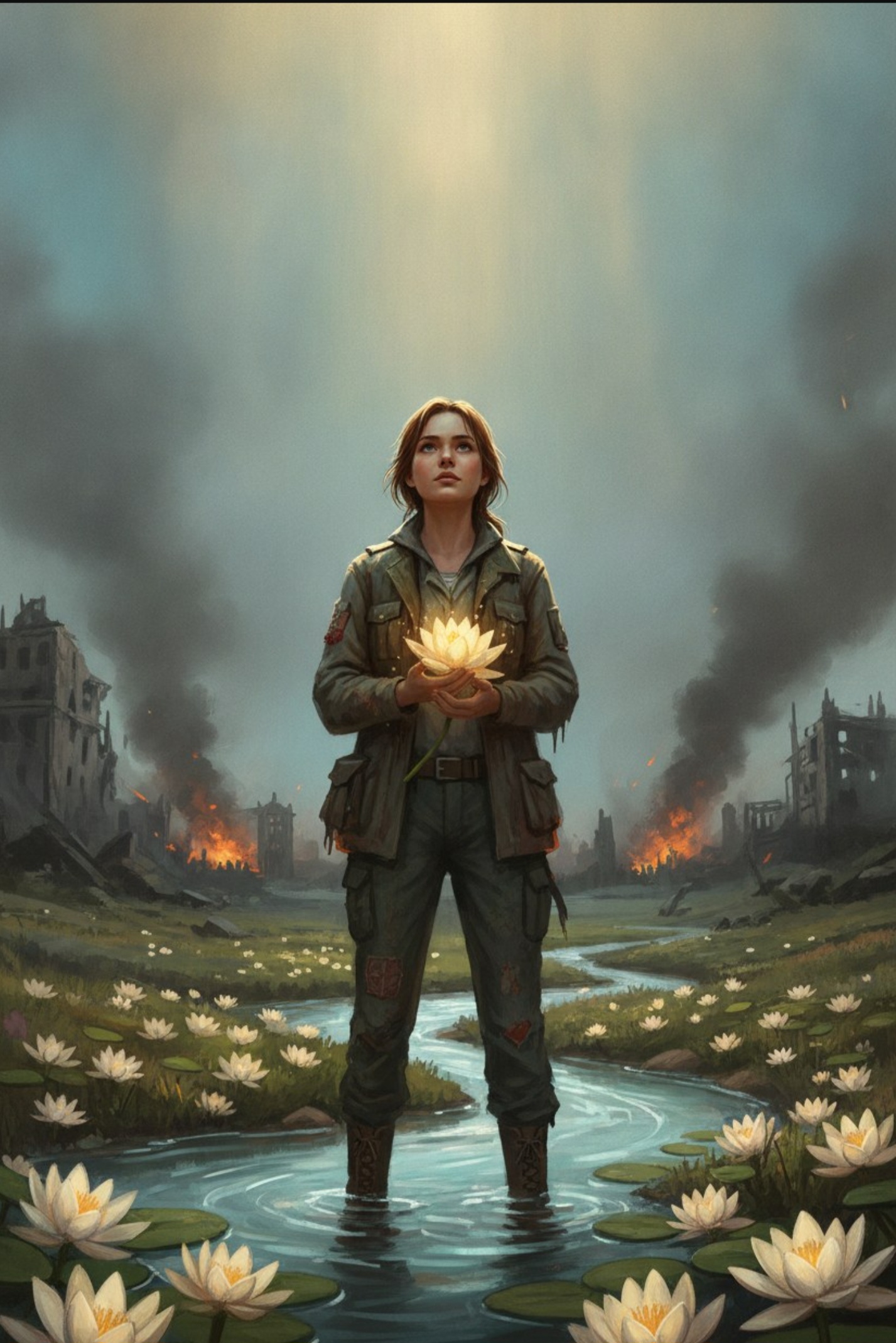
The first of September arrived. Kostya was taken to school. “How much he looks like his father,” Anna and Dina noted to themselves. In those words there was both pride and a sharp, cutting pain. The past broke through the present for a second. Reminding them of the way the father’s voice sounded when he spoke about his son. How he laughed, how he tossed him up toward the ceiling.
The day began almost as in peacetime. The sun shone brightly, the air was cool. And not harsh, as in winter, but clean, as if washed by rain. Kostya was put in a shirt his mama had bought back in spring “to grow into.” Now it fit, but still seemed a little loose. He had not quite managed to grow into it yet. In his hands was a bouquet—asters gathered on the vacant lot near the house. Purple, white, dark red, as if someone had specially chosen the colors so they would remind of both celebration and unease.
They walked down the street. Dina tried to smile because Kostya was glancing at her shyly. He wanted to make sure everything was all right. “Don’t worry, you can do it,” she whispered to her brother. Those words sounded like an attempt to hold the world in place.
Everything went as usual until the sound of the siren came. It was not like before. Not distant, not a blurred echo, but sharp, piercing. One might have thought someone had struck a taut string right above their heads. Dina’s vision went dark. For a moment time seemed to split. She saw at once today and all the days before. Those very days in which that sound meant disaster. And every time disaster came.
Shots rang out—short, angry, like hammer blows on glass. People screamed around them. Those screams were no longer childish. Adult, full of despair, because adults understood what was happening faster. People rushed toward the school, pressed children to themselves. Covered them with their hands, hoping they had managed to make themselves a shield.
Her brother, holding the bouquet of flowers, suddenly seemed to freeze in place. It seemed he had heard something the others had not. Bright petals scattered over the asphalt, mixing with dust. With something else dark that she did not want to see. He did not fall at once—first he swayed. The ground went out from under his feet, and then he slowly sank down. The movement was so unnatural that her brain refused to understand it.
Mama grabbed him in her arms and broke into sobs. That sound—not weeping but a howl torn from the very depths—pierced Dina through like a shard. She felt everything inside her contracting. Her heart itself was trying to force its way out of her chest. Dina slowly sank onto the asphalt. The world around became gray, flat, stripped of colors. Then she lost consciousness.
She came to in the hospital. Reality was grim. White, sterile, but soaked through with others’ grief. The smell of medicine and bleach bit into her nose. It seemed that even the air here was alien. The girl had not been at Kostya’s funeral and had not seen him in the coffin. Her brain refused to accept that he was gone. When her father died, she had at least been able to say goodbye at the cemetery during the burial of the body. But now there had been nothing like that. It seemed to her that he had gone far away. This illusion helped her keep from going mad: “My poor mommy. How hard it is for her. But it is easier for me. For me, my little brother is alive in my heart. I am not ready to renounce that.”
After being discharged from the hospital and returning home, Dina felt the silence pressing harder than any scream. The photographs of father and Kostya were tied with a black ribbon. Candles were burning in the lampada, and an iconostasis stood there. “A very gloomy corner,” Dina thought. “I will never look here again.” But her gaze was drawn there on its own, as if pain beckoned. Testing Dina’s strength and how much more she could endure.
As she walked through the room, memories overwhelmed her. How her brother had been brought from the maternity hospital in an envelope tied with a blue ribbon. Father had even joked then: “Sleeping Beauty.” Before her eyes flashed Kostya’s first steps, his pranks, their work together. With a bitter sigh, Dina climbed onto the windowsill. It was dangerous, but what was there left to lose now? On her knees lay a diary with an entry that tore her tender soul to pieces: “Kostya is gone.” Closing her eyes, she dreamed of dissolving and waking up not here. Not in this city, where every sound could be the last. Where every day was a trial no one had asked to endure.
She looked out the window at the frost patterns. She thought those lines resembled cracks in her heart, just as thin and deep. If she pressed a little harder, everything would shatter into pieces. At that moment she was afraid. Afraid not of what might happen next, but of how much pain had already fit into her small chest. And how, after all this, could she still breathe?