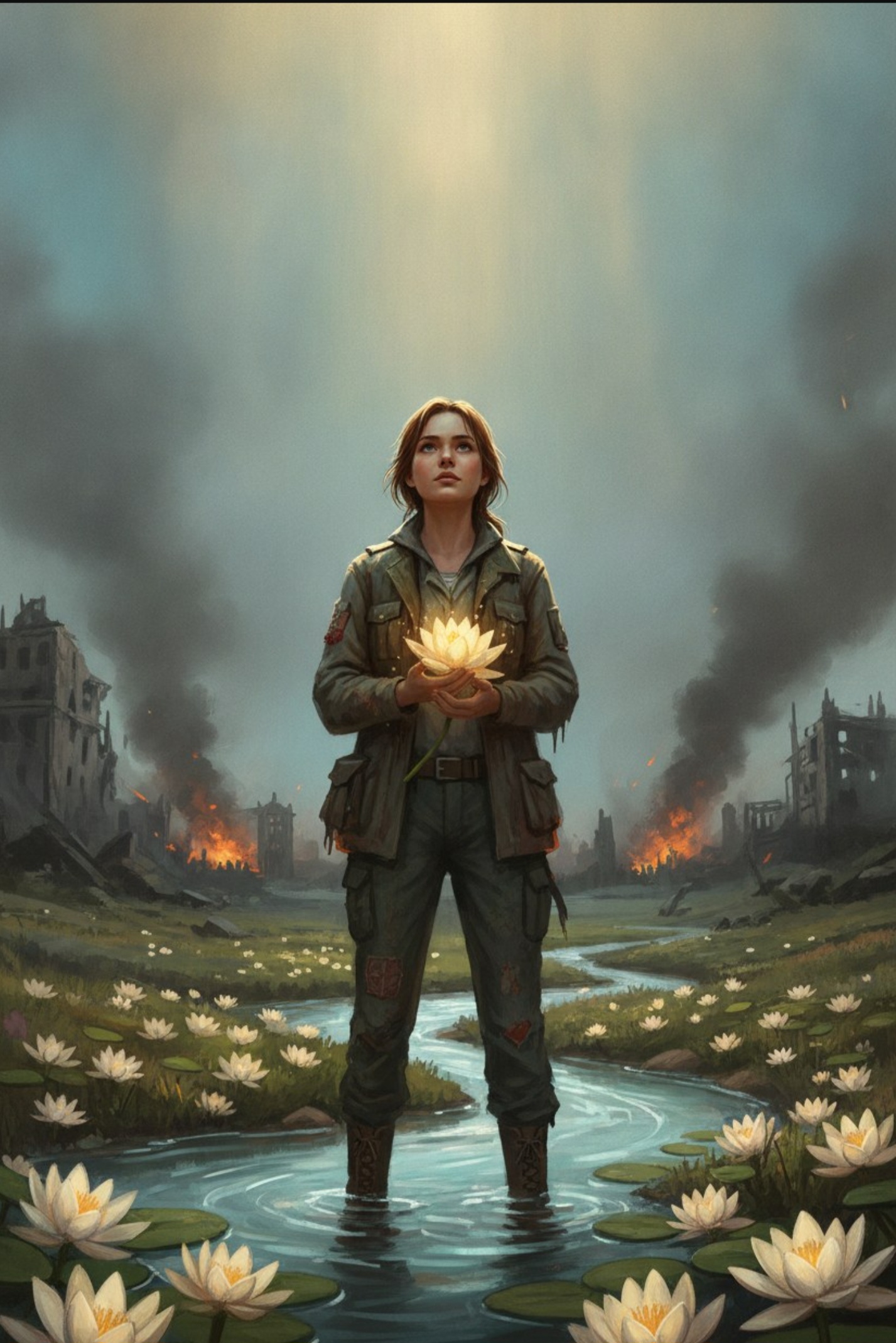
That weekend the sun lay on the park paths like heavy, warm gold. Time itself had decided to slow down, to give people at least a little quiet. Dina walked beside her mother. A little ahead walked Olga, their new acquaintance. With eyes in which life now splashed so desperately that even the air around her seemed fresher.
Olga no longer hid her gloom in the folds. Her face had smoothed out, as if the wind had finally blown from it the old soot of loneliness. Fine rays had appeared at the corners of her eyes because she had learned to smile again. And when Dina took her by the arm, Olga did not start, did not pull away. On the contrary, she pressed a little closer, as if checking: “Is this real? I’m not alone?”
“You know, Dinochka,” Olga said quietly all at once, not looking at the road but somewhere through the trees. To where the sky merged with the roofs, “I used to think silence was when no one speaks. But now I understand: silence is when there is someone nearby who doesn’t have to prove anything. Who is simply there.”
Dina smiled, but something trembled in her chest. From the weight of understanding: how many years Olga had lived in that false silence until this small, fragile, but stubborn connection appeared.
“You’ve become like a granddaughter to me,” Olga said simply. And it was the most ordinary confession. “And you know, I’m not even afraid to say it aloud. Because you won’t wave it away. You hear.”
Dina stopped, turned to her, took both her hands in hers—warm, dry, with the fine lines of time—and said firmly:
“I hear you. And I’m not going to disappear anywhere. Even if it’s noisy. Even if it’s frightening.”
Anna looked at her daughter and Olga, and a spark of joy flared in her eyes.
They stood like that for a long time, the three of them in the middle of the park. Amid laughter and the din of birds. At that moment the whole world seemed to grow quieter—so as not to frighten away this fragile but so necessary truth.
And in the evening, when Dina came to visit Olga—no longer as if she had “dropped in for a minute,” but as if into her second home. They sat by the window, where a teapot was cooling on the sill and a thin, worn book lay there: the New Testament with the Psalter.
“Here, look,” Olga ran her finger along the lines, as if stroking someone’s invisible hand. “Psalm one hundred thirty-eight. It’s all about how not a single day is lived in vain, even if it seems empty. That every breath is in its place. That God knows all our days even before we live them. Not to take away freedom, but so that we don’t feel lost in this vast world.”
Dina bent over the pages, feeling how the letters formed not words but a support.
“But why, then, are some given so little?” she asked quietly, raising her eyes. “Why does someone barely manage to be born and then leave at once, while another lives almost a whole century, sees so much… It’s unfair.”
Olga was silent for a moment, then sighed—not heavily, but as if she were letting out an old resentment that had long since dried up and become mere dust.
“Justice, little one, doesn’t always mean ‘equally.’ Sometimes it means—to each according to his strength. For some, one dawn is enough to manage everything they needed. And another is given a whole life so that he can learn not to fear the dark. The Creator has balance and harmony in everything—even in what seems to us the most terrible injustice.”
Dina closed the book and pressed it to her chest, as if she wanted to take this quiet, wise voice with her. And suddenly she understood: these pages would now travel with her—to where silence can be deafening and words become a shield.
The last day of practical training. The phrase itself sounded like a promise: just a little more—and she would be able to simply breathe, not counting breaths, not checking them against the rhythm of someone else’s pulse.
“How I want a real holiday,” Dina thought, standing by the window of the medical station, where the glass was taped crosswise. Beyond it stretched gray streets, as if drawn in charcoal. “To just sit on the grass, look at the sky, and think about nothing. For summer to be not a date on the calendar but a taste—of strawberries, wind, freedom…”
But time, as always, did not wait.
By noon an order came: a mobile PVN with a medical group was moving out toward the “red zone.”
Everything inside Dina clenched—not from fear, but from that very cold composure. The kind that comes when you understand that right now you cannot be weak, cannot doubt. Only do.
The vehicle smelled of iron, gasoline, and something else—astringent, bitter, like foreboding. Ivan Ivanych, the “Driver,” sat behind the wheel, calm as always, as if he were driving not to the epicenter but to the next street over.
“Hold on, kiddo,” he threw over his shoulder without turning. “The road will be bumpy, but we’ll get there.”
Vasily, the medic, silently checked the kit and clicked the fasteners—the sound rang out in the silence like a gunshot.
And Dina opened the Psalter. Because she believed that the words written there would become an anchor for her soul. While she read, the world narrowed to a line, to a letter, to a breath—and in that small circle there was no room for panic.
As they approached the contact line, the air became different. Thick, ringing with tension. Here even silence was dangerous. It meant the enemy was listening.
Drones buzzed somewhere high above, like angry wasps. Every sound they made sent her heart leaping into her throat. Vehicles with red crosses here were not a symbol of help but a target. And everyone knew it.
But that day the sky was silent. No shots, no explosions—only the wind humming in the cracks of the vehicle body. The clatter of wheels, like a hurried heartbeat.
They were picking up two people.
The first—in a grave unconscious state. A young man with a face that had not yet had time to become adult. He was carefully, almost soundlessly, laid on a stretcher. Dina, bending over him, suddenly caught herself whispering: “Hold on. You’re not alone. We’re here.”
The second—with a serious wound in his arm. He was conscious, clenching his teeth so hard that the muscles moved on his cheekbones. But even in that tension there was a stubborn will to live in him.
“It hurts,” he said briefly, as Vasily applied the bandage. “But I want to live.”
Those words struck harder than any shout.
On the way to the “yellow zone,” the wounded man—the one with the arm wound—suddenly began to speak. He spoke not of pain, not of fear, but of something that seemed almost impossible in that hell.
“You know,” he began hoarsely, looking at the ceiling of the vehicle, “we had a case… Last week. We were holding a position, hell all around, the ground shaking, and our canteens had run out of water. And then, out of nowhere—a dog. Dirty, skinny, but its eyes… like it knew where to go. And it went. And we followed it. And it led us to a spring. Right to the water. And you know what’s strangest? Not a single shell fell there. Not one. As if someone had covered us.”
He fell silent for a moment, then added quietly:
“Maybe it’s just a coincidence. And maybe not. But now I believe that as long as you’re doing your job, as long as you don’t abandon those beside you, someone is watching over you. I don’t yet understand who He is, that someone. But there’s definitely something there. And he nodded, fixing his gaze upward, at the sky.”
The vehicle drove on, rocking over the potholes. And the soldier’s words hung in the air—not as consolation, but as truth, heavy and simple as bread.
Dina looked at the road, at the flashing poles, at the sky, which was growing darker and darker, and thought: “Yes, I didn’t see the summer. But maybe summer isn’t only sunshine. Maybe summer is when you understand that you’re not alone. That beside you is the One who holds you even when you can barely stand.”
And in that moment, it became a little easier for her to breathe.