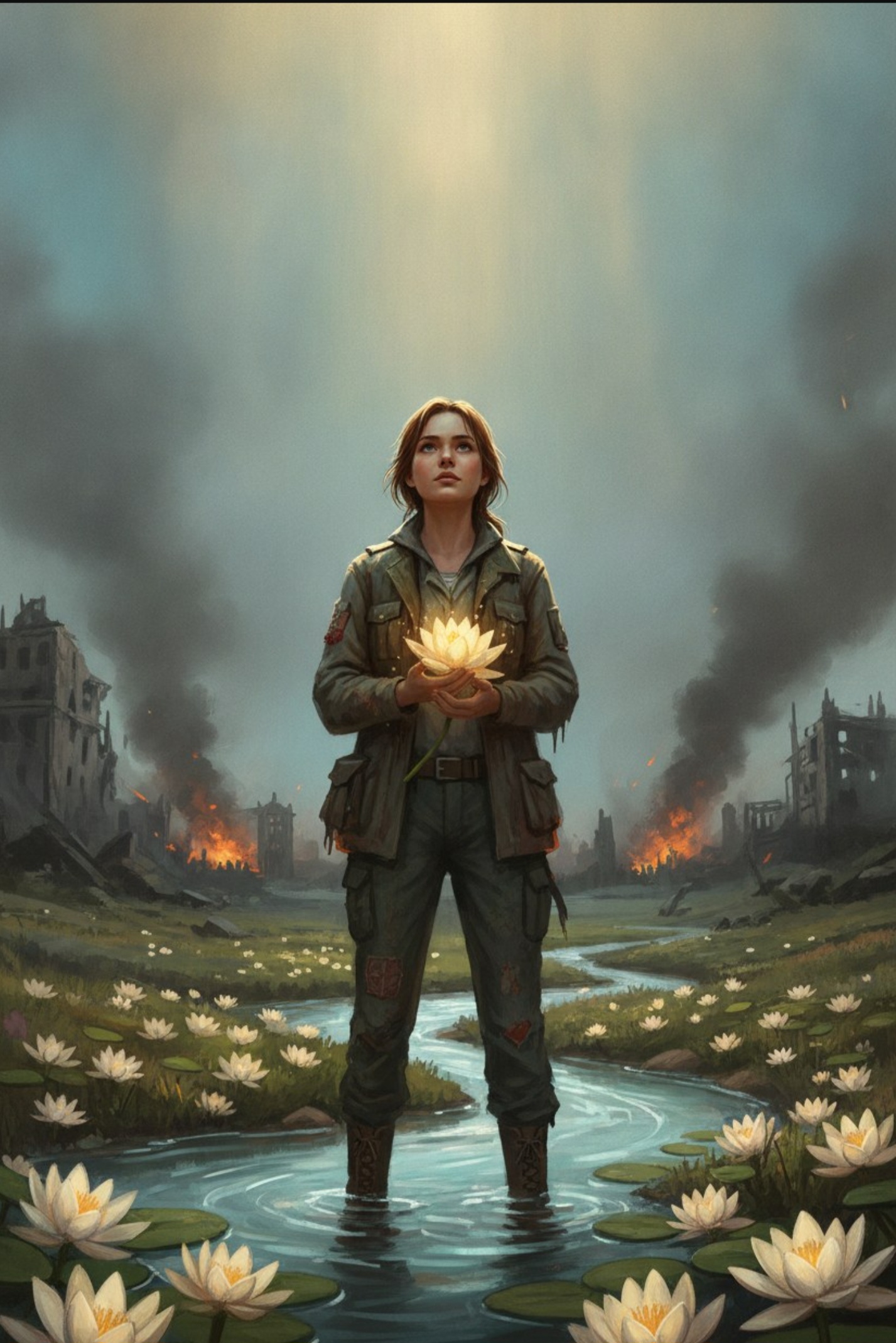
The next day a boy was brought into intensive care. A shrapnel wound to the abdomen. It seemed life itself was draining out of him drop by drop. He was fair-haired, pale to an implausible degree—his skin seemed to have grown thinner. It had become transparent, and through it showed a fragility that made the heart clench. His delicate features looked as if molded from something too fine to withstand this world. His skin glowed with a dim, waxy light. Could it be that he already half belonged to the silence where there are no cries or tears? Only occasionally did he half-open his eyes. In them was such a sharp, piercing anxiety that it hurt to look. He really did resemble a wax doll. But a doll that was about to crumble from a single awkward breath.
The prognoses sounded like a verdict pronounced in a whisper so as not to frighten away the last hope. The doctors exchanged glances, spoke of risks, of the fragile balance between life and death. Anna, Dina's mother, stood by the glass partition and looked at him as if trying by sheer willpower to keep him here, in this world.
And he, regaining consciousness, suddenly called softly, almost without voice: “Mama…”
And that one word struck everyone who heard it. Comparable to the toll of a bell in an empty church. So resonant, merciless, forever. He did not yet know that he had been left an orphan. That after the raid, not a single adult who would wait for him remained in his world. That a weight had already settled on his fragile shoulders that no one should have to bear, especially not a child.
Anna flinched every time she heard that call. The boy reminded her of Kostya. Her son, whom she had lost. Memories rolled in in waves, sharp as shards of glass. There he is laughing, there he reaches out to her. There he whispers something before sleep… And from these memories tears flowed of their own accord, and the lump in her throat grew so large that it seemed it would choke her. But she drove these thoughts away. She knew that if she allowed herself to drown in the past, she would have no strength left to save the one who was now fighting for his life.
Dina was gradually coming back to life. A week in intensive care—and at last she was transferred to a ward. Recovery after open-heart surgery is not just days; it is a battle for every breath. For every step, for the right to feel alive again. Catheters, sensors, tubes—all of these were gradually removed. And inside her there still lived that same silence that comes after being close to death. Breathing exercises, careful movements, the fear of doing something wrong. Her mother was always nearby, holding her hand and whispering, “You'll manage. You've already managed.”
Dina spent almost a month in the hospital. During that time the world had managed to change a little. A new academic year had begun; her fellow students were already sitting in lectures, taking notes, laughing in the corridors. Only she lay in the ward and learned to trust her body again. A six-month academic leave sounded not like a defeat but like a forced respite—to gather herself back together piece by piece. Her fellow students and teachers visited her. Each of their visits was like a breath of fresh air. They brought news, jokes, small gifts. With that they reminded her that she was still part of this world, that she was awaited.
On the day of discharge Anna stood beside her. In her eyes one could read something greater than mere relief. She held Dina's hand tightly. She was afraid that if she let go, everything would fall apart.
“Dina,” Anna's voice faltered. She closed her eyes for a second, as if gathering strength. “That boy… the orphan… I've grown so attached to him. Every time he calls for his mother, something inside me breaks. I know what it's like to lose a son. I know how hard and lonely it is when there is no one left in the world who is waiting for you. What do you think… maybe we could take him in? Let him not be alone. Let him be with us.”
Dina smiled—but it was not a light, carefree smile. In it there was so much pain, so much understanding. So much desire to save at least someone that it seemed almost sacred. They had become friends in intensive care. Their gurneys had stood side by side, separated only by a thin screen. She could not hide her moans, her whispers, or her tears. They shared one space, one silence, one fear. Now Dina felt that she could not leave him alone.
“I thought about it too,” she said quietly. Her voice trembled slightly. “It seems to me… we'll all get along. And let there be a few more happy people on earth. Let him have a home. Let him have us.”
Anna nodded. A tear rolled down her cheek—from relief, from the fact that she was not alone in her desire to save.
“I'll arrange everything,” she promised, wiping her cheek. Now she was taking on a new, very important responsibility. I'll talk to the administration and fill out all the paperwork. And then… then I'll tell him. Not right away, of course. First he needs to believe that he won't be abandoned. That there is a place where he is awaited. And if this is God's work, it will come together smoothly. Let it be so.
And at that moment, amid hospital smells, white walls, and muted voices, something fragile but incredibly strong hung in the air—hope. The very kind that is born not from loud words but from a quiet “I am with you.” From the readiness to share another's pain and make it a little easier.