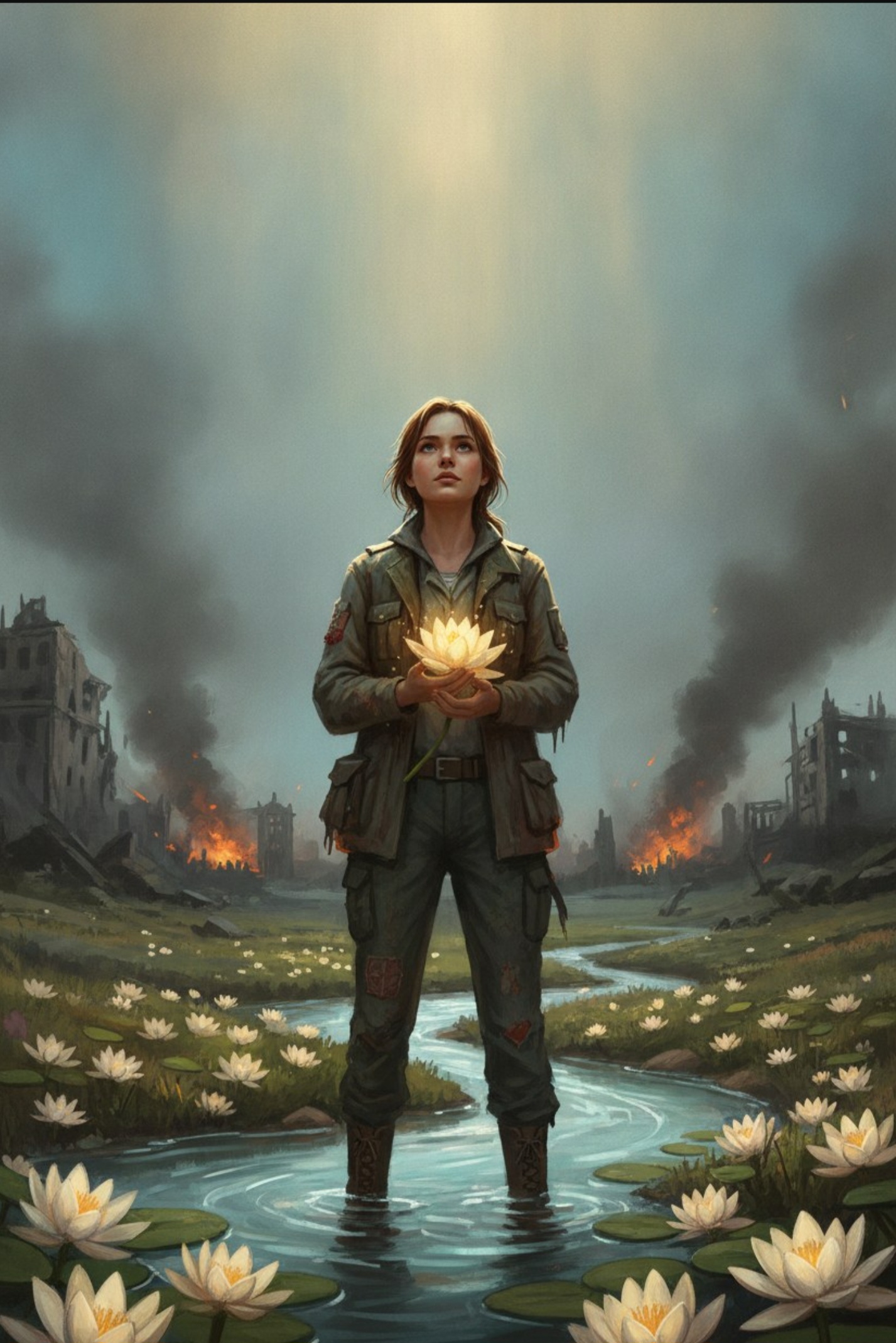
Mission after mission became routine. In the most alarming moments her heart no longer skipped a beat. “She had grown hardened,” as people said. The habit of seeing wounds and death became part of the reality in which Dina lived. But this “hardening” was not armor. It was a crust under which it still hurt. Dina had simply learned not to show it. What could you do—at such a time and in such circumstances a person learns to hide the trembling in their fists and speak in an even voice, even if everything inside is screaming.
Of course, dreams remained. Without them a person is just a walking corpse. It is important to strive for a goal and at least try to achieve it. But lately dreams had seemed to Dina fragile, like glass in a broken window. One sharp breath—and they would crumble into sharp shards.
What did Dina dream of? Of a peaceful sky, of well-being for herself, her mother, and all people in general. Why live if there would always be war and grief? The earth was not created for that. And yet she clung to that thought. Like a handrail in a shaking van when the road goes downhill and the brakes barely hold.
The situation during practice was different. Sometimes a silence that made your ears ring. Sometimes an emergency when seconds were counted not on your fingers but by heartbeats. There was no time left for herself. Sometimes it seemed to her that she had stopped being herself altogether—only a function remained: “Dina, out on a call!”, “Dina, hold the pressure!”, “Dina, don’t let go!”
Her favorite place to rest with her mother was the city park. Almost nothing remained of what had once pleased the eye. Much had been destroyed. But memory preserved that adornment. Passing by torn-up paving slabs and charred trunks, Dina seemed to see through time: neat paths, streetlamps, benches where she and her mother had laughed at something simple. In spring and summer the park came alive with flowers and greenery, lending coziness even to damaged places. Caring people were restoring it. They put up benches, laid out flower beds, planted trees. As if trying to stitch the torn fabric of the city together with stitches of hope.
Deep in the park there was a dammed pond, where wild ducks and geese used to live. Now they were gone, but there were many pigeons and sparrows. The birds created an atmosphere of life—bustling, nervous, but real. Their sudden takeoffs frightened Dina, reminding her of sudden shelling. The same brief instant between silence and thunder.
Mother and daughter liked to sit by the pond when it was calm. Watch the ripples on the water and listen to the rustle of leaves. They talked about unrelated things and rested their souls. She wanted to go somewhere quiet and peaceful, where the word “alarm” meant only a slight worry before an exam, and not the wail of a siren.
One day, coming to the pond, they saw an elderly woman on a bench. On her face were traces of loss. As if grief had left on it a map of long roads. She was dressed simply; it was clear she lived in need. In her hands she held an open book and was reading. There was so much persistence in this quiet occupation that Dina involuntarily held her breath, afraid to frighten away this little island of peace. They greeted her and sat down nearby.
“Hello,” her mother said quietly, as if afraid to break the fragile silence. “May we sit down?”
The woman raised her eyes—in them was weariness, but not emptiness; rather some stubborn composure.
“Sit down,” she nodded. “There’s enough room here. And I don’t like sitting alone. Loneliness makes too much noise.”
Dina involuntarily shuddered at these words. This woman had spoken aloud what she herself felt at night, when the city grew still. Her thoughts began to thunder louder than any cannonade.
The woman introduced herself:
“My name is Olga. I’m rarely here. More often at the cemetery. After the death of my son and husband, I couldn’t make myself go on living. For a long time I gathered my strength and learned to live without them. Reading Holy Scripture and prayer helped me cope with grief alone.”
She lifted the book from her lap. In her fingers was felt a weariness that does not pass with the years:
“Here it is. After the funeral I went to the church every day and prayed to find peace. But the pain did not pass. The peace was incomplete. On the way to the church I struck up a conversation with an elder. He said: ‘If you do not read the holy Gospel, you will not find peace and salvation for your soul. I’ll bring it to you tomorrow; I have one left from my wife.’ And so he brought it. Now I read it. The Psalter helps especially. Would you like me to read one?”
Dina wanted to say no. It seemed to her that someone else’s words would now sound like mockery of what she saw every day. But her mother quietly squeezed her hand, and instead of refusing, Dina simply nodded.
Olga read Psalm 90, “He who dwells in the shelter of the Most High”:
— “He who dwells in the shelter of the Most High, who abides under the shadow of the Almighty, says to the Lord: ‘My refuge and my fortress, my God, in whom I trust!’ He will deliver you from the snare of the fowler, from the deadly plague; He will cover you with His feathers, and under His wings you will be safe; His truth is a shield and a rampart. You will not fear the terrors of the night, nor the arrow that flies by day, nor the plague that stalks in darkness, nor the pestilence that ravages at noon. A thousand may fall at your side, and ten thousand at your right hand; but it will not come near you: you will only look with your eyes and see the recompense of the wicked. For you have said: ‘The Lord is my hope’; you have chosen the Most High as your refuge; no evil will befall you, and no plague will come near your dwelling; for He will command His angels concerning you to guard you in all your ways: they will bear you up in their hands, lest you strike your foot against a stone; you will tread on the asp and the basilisk; you will trample the lion and the dragon. ‘Because he has loved Me, I will deliver him; I will protect him, because he has known My name. He will call to Me, and I will hear him; I am with him in sorrow; I will deliver him and glorify him, I will satisfy him with length of days, and show him My salvation.’”
Her voice sounded quiet but firm, breaking through the city noise like a ray of light through cracks in shutters. When she finished, silence hung in the air. Not empty, but thick, as if the words were still hanging there, not letting the noise of the city return at once.
“Thank you,” her mother whispered, and in her voice there was such sincere gratitude that Dina’s eyes stung.
“You’re welcome,” Olga replied, lowering her head slightly. “Words don’t heal wounds, but they help you not to lose your mind. That’s already a lot.”
“And does it… does it help you?” Dina asked unexpectedly even to herself. Her voice came out hoarse, as if she had been silent too long.
Olga gave her a long look, one that held neither pity nor preaching — only understanding.
“It helps you not to drown,” she said simply. “There are days when I can't get out of bed. And then I remember: today I promised myself I'd read at least one line. And I read it. And that's already a victory. A small one, but my own.”
Dina clenched her fingers into fists, feeling something shift inside her. Not from fear, but from a strange sense of recognition, as if those words had been written especially for her.
Olga talked with them a little while, telling them how she had learned to notice the small things again. The smell of wet grass, the shadow of a cloud, a child's quiet laughter. There was no comforting lie in her words, only the bitter truth that she had managed to turn into something to lean on. Then she stood up and said before leaving:
“I hope we'll see each other again. All the best.”
They agreed on times to meet, and when Olga had gone, Dina suddenly realized that for the first time in a long while she didn't want to run back to her duties. To run back to the anxieties, to the endless routes. She just wanted to sit and feel her heart beating not from adrenaline, but from something else.
That evening, sitting on the windowsill and looking up at the sky, Dina wrote something in her diary. On her face was a peaceful smile. Though a shadow of anxiety still lived in her eyes — like the glow of a distant fire. The meeting with Olga had changed something in her. The words from the Psalter, like life-giving energy, had helped her see life in a new light. A thought crept in that someday everything would be different, that dreams would come true. But now that thought no longer seemed to her crystalline and ready to shatter. It had come to resemble a shoot that had broken through the asphalt. Thin, but stubborn, ready to fight for every millimeter of light.
And when the phone on the windowsill beeped briefly, announcing a new call, Dina didn't flinch. She closed her diary and took a deep breath. As if drawing strength not from coffee or sleep, but from that very silence she had managed to catch today by the pond.
“I'll manage,” she told herself. This time those words were not empty bravado. It was a promise — to herself, to her mother, to that girl who had once dreamed of simply having a quiet evening without sirens. And she intended to keep it.