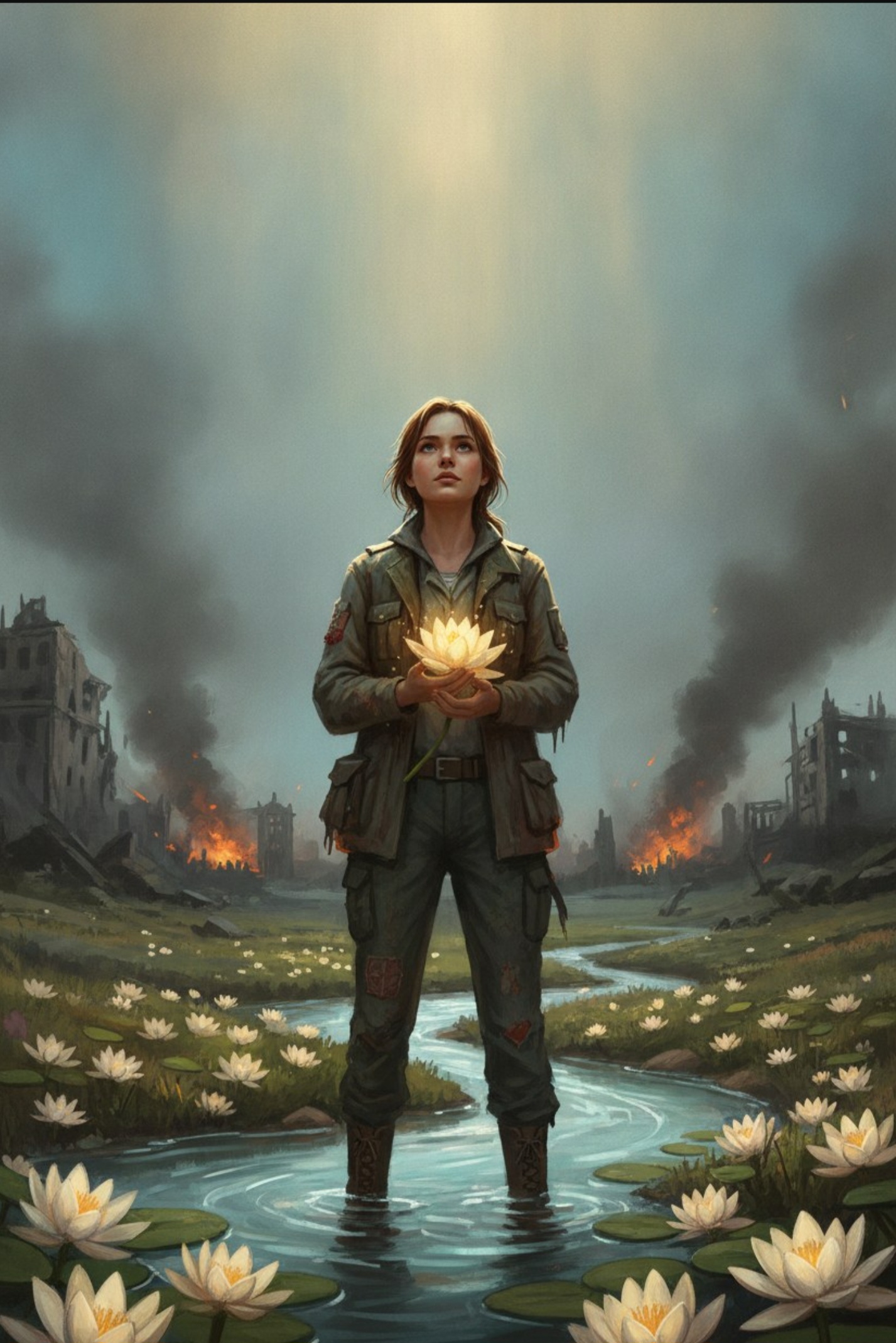
After getting off the bus, they looked around. Raigorodok, a small settlement. Like a sparrow huddled from cold and fear. It looked not merely gloomy but as if the very air here was soaked in loss. In some houses the windows had been smashed out. Dark openings gaped like empty eye sockets. Tilted fences resembled broken bones. Potholes blackened the roads. Not mere holes but as if traces of someone’s desperate attempts to escape. Along the roadsides, as if abandoned to their fate, lay the burnt-out skeletons of cars. The metal had turned gray, in places covered with a rusty crust. Here and there an almost imperceptible smell of burning, ingrained into the earth, still lingered. The streets were empty; only now and then hurried, hunched figures of people flickered past. They moved quickly without raising their eyes. As if afraid that any glance into the void might take away their last warmth.
Anna knew where the cemetery was, but she did not lead everyone straight there. She let Misha choose where to go first. In this quiet, in this silence, there were more words than in any consolation.
“Let’s start with the cemetery,” he suggested quietly, almost in a whisper. He was afraid that a loud voice would frighten away the fragile connection that still stretched from him to his parents.
Everyone nodded silently. No one objected, no one tried to distract him or turn the conversation to something ordinary. They set off. Every step along the broken road echoed heavily inside them.
Passing a field, Dina noticed bright autumn flowers. They grew right by the roadside, desperately clinging to life. These last messengers of departing warmth stood out sharply against the gray background. Looking at their colors was almost painful. It seemed nature itself was mocking them, showing a scrap of beauty where there should be none.
“Let’s gather bouquets,” she suggested to Misha. Her voice faltered, betraying her attempt to hold on to at least a drop of light in this gray world. “They’ll freeze soon. But this way… let them not be for nothing. Let them become something.”
He nodded, unable to utter a word. They gathered two large bouquets. Having tied them with sedge, they paused for a moment, as if these simple stems could hold together a crumbling world. Then, without looking at each other, they continued on their way.
The old cemetery hid among thickets of hawthorn and raspberry. It seemed to be trying to hide from prying eyes, to dissolve into wild, indifferent nature. Tilted crosses covered with moss stuck out of the tall grass like forgotten traces of the past. Like mute reproaches to those who had left and had not managed to say everything. The paths had grown over with plantain and dandelions. Between the graves grew lilac bushes. Their bare branches bent over the tombstones as if whispering eternal rest. In that whisper there was no comforting silence. Rather the opposite: a bitter reminder that time does not heal; it merely erases the edges of pain, making it habitual.
The air was thick, heavy, saturated with the smell of damp earth, rotting leaves, and the last flowers. The smell of the end, the smell of what cannot be returned. The silence was broken only by the rustle of wind in the crowns of old birches, like someone’s restrained weeping. The rare cries of rooks, sharp as blows against taut nerves.
The first rows of old gravestones were screened by new ones. Brand-new ones, with crosses rising above them like silent guards of someone else’s misfortune.
“Here are ours,” Anna said, and in her voice there was neither firmness nor consolation. Only that weary, scorched pain that comes when you realize nothing can be fixed anymore.
Two fresh graves with plaques on the crosses, put up by neighbors and friends. They looked orphaned without fences, without the usual little things that make a grave resemble a memory rather than a mark on the earth. The ground around them was still loose. Dark patches of damp had already appeared on it, as if the earth itself were weeping.
The boy came closer, slowly; every step cost him a piece of himself. He laid down the bouquets and fell silent. He stood before his parents’ graves with a sorrowful face, on which could be read not merely grief and emptiness, but that ringing silence when everything inside is screaming, though not a sound comes out. He looked at the ground, trying to find answers to his questions. And saw only silence and cold. In that silence there was so much finality that it seemed more terrifying than any scream.
Dina and Anna embraced him from both sides, tightly, so that he would feel he was not alone, even if the whole world now seemed empty. Everyone’s eyes glistened with tears, but no one tried to wipe them away. Those tears were the only honest thing on this unjust day.
Thoughts raced through the boy’s head, sharp and merciless: “Now I know for certain that my parents died. This is not a mistake, not a terrible dream, not someone’s cruel joke. Having said goodbye to them, I need to come to terms with the loss and find the strength to live on. But how can I live if a part of me has remained here, in this damp earth, beneath these tilted crosses?”
Turning to his newly made family, he said quietly. His voice broke on every word, as if each one cost him an unbearable effort:
“Thank you… Without you I wouldn’t have made it. I simply… wouldn’t have been able to stand here. I wouldn’t have been able to look at this.”
Tears burst from his eyes, hot and heavy. He didn’t even try to hold them back. Who said men don’t cry? After all, our Misha had grown up beyond his years after these events. But it was precisely in these tears that his true strength lay. Not in being made of stone, but in not being afraid to show how much it hurts.
“Time to go,” Anna said quietly, and in that “time” one could hear not a desire to run away but a bitter necessity. You can’t stand in one place when the ground beneath your feet becomes too unsteady.
They headed toward the exit. A cold wind tugged at the leaves, reminding everyone who was master here. True, this time there was no triumph in its whistle, only the indifferent, icy truth. The world kept turning even when someone’s worlds were collapsing.
←
The Girl from Donbass
Chapter 16 · 16 of 18
Chapter 16
~4 min