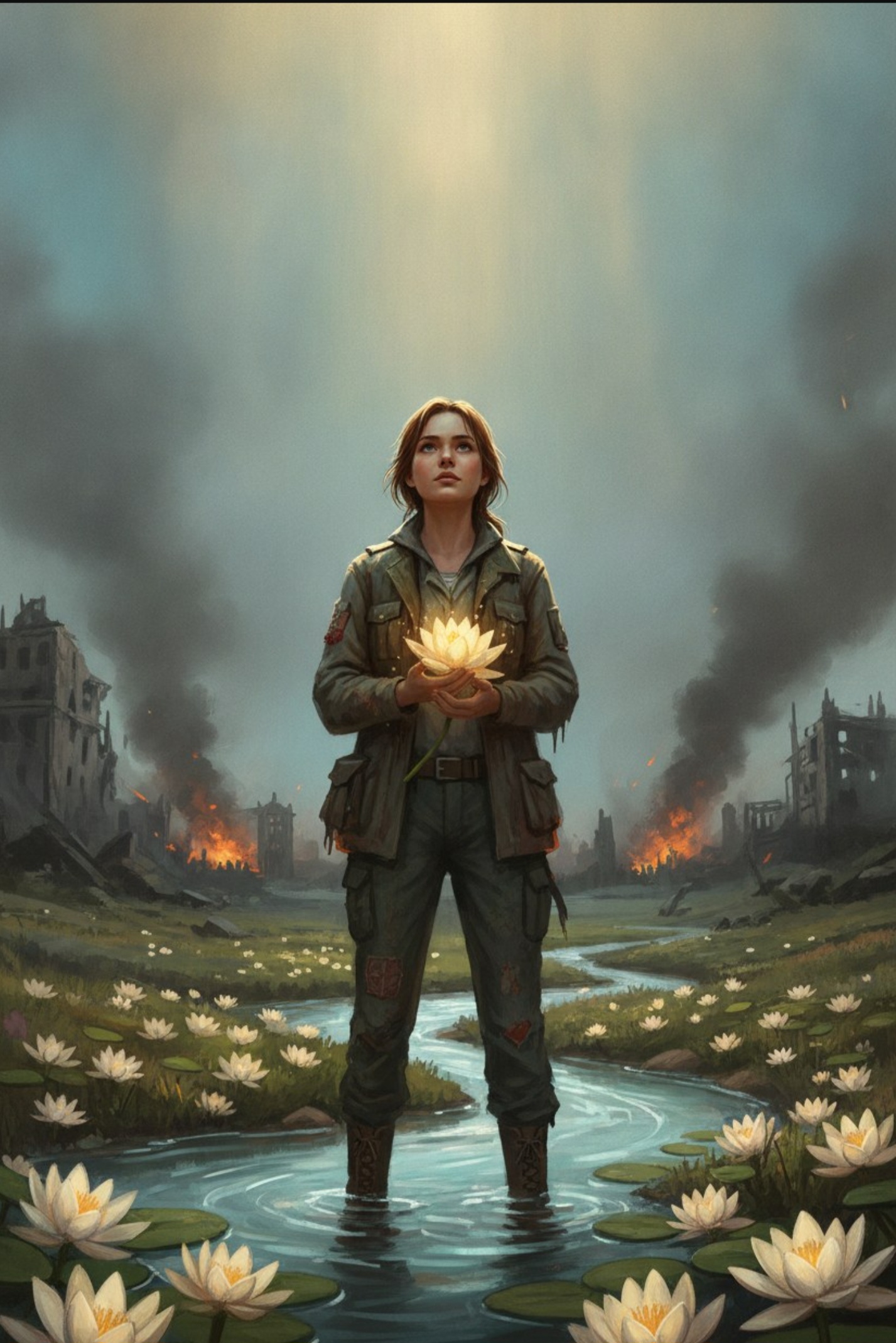
There it was—the home that had once been his own.
And there was the gate—like a frozen frame from a past life that now stung his eyes with its implausible ordinariness. Misha’s heart began to pound faster—so hollowly and desperately, as if it were trying to break through that silence, to cry out: “I’m here, I’m alive, but they… they’re gone.” Dad had installed a new latch just recently. He had shown it off with pride, how evenly the metal settled into the groove, how softly the lock clicked. And Mom had painted the little fence that very light blue—“like the sky on a clear day,” she’d said. Ah, did they know that this color would become the last bright spot in his memory? Did I know… That thought scratched from inside, sharp as a shard of glass under a boot.
The roof had collapsed on one side, but it was still possible to go in. It seemed fate had left a narrow gap to let them peek into the past. Though it had not allowed them to stay there. It was still light outside, but that light no longer warmed. It only exposed the destruction, made it even more merciless. “If we can’t see well, we’ll turn on the flashlight,” Dina said. That everyday phrase sounded absurdly out of place among the ruins. They climbed onto the porch. The boards creaked underfoot. They seemed to groan themselves under the weight of what had happened, and they opened the door.
Once they entered the house, the heaviness was immediately felt. No, not just dust and debris. The silence itself here was thick, almost tangible, as if it had absorbed all the unspoken words. All the screams that had never sounded that night. The walls seemed saturated with something heavy, alien, and the air was soaked with something suffocating. With the smell of grief, loss, the end. In the hallway Misha stopped, unable to take another step. A thought kept spinning in the boy’s head: “This place is a memory of them, and it will never be the same. It is a monument now, not a home.” Forcing himself to go on, he asked Dina and his mother to go ahead first. It seemed to him that if he went first, he would finally destroy the fragile something that still remained of his childhood. He himself did not dare—his legs seemed to have filled with lead, and his throat tightened so much that even an inhale came with difficulty.
After the shell hit the roof of the house, traces of soot remained. Black, clinging, they spread over the wood like evil shadows of the past. Around the breach a halo of soot and traces of flying shrapnel remained. As if someone had drawn a circle into another dimension around the hole. The windows had been blown out; inside, the shockwave had smashed to dust everything that had once been part of their comfort. Shelves, frames, even the air, it seemed, had shattered into sharp shards of memory.
The boy took his mother Anna by the hand. Her palm was warm, real, and for a second that warmth broke through the icy crust that had bound him from within. He pointed: “My parents’ bedroom is there.” The impact point was directly above it. Those words hung in the air, heavy as stones. No one dared to pick them up.
They tried to enter the bedroom, but it was no use. The roof had collapsed; there was no way in. As if fate itself had closed that door forever. The boy spoke, and his voice faltered. He stubbornly clenched his teeth so as not to cry:
“I hope they didn’t feel anything and died in their sleep. Let that be true. At least some truth that won’t tear me apart inside. And my room is here, but the wall collapsed and covered everything, too. I’ll try to look in there, maybe something survived. I’d like to find my football; it was under the bed. Dad gave it to me for my tenth birthday. We really loved playing football with him. He always shouted, ‘Come on, shoot! Show me what you’ve got!’—and laughed when the ball flew past the goal, because he knew that next time I’d definitely score.”
Just about a month and a half ago, this had been a cozy boy’s room. On the walls were posters of spaceships and famous footballers. By the window, a neatly made bed. On the shelf, a collection of model airplanes lined up in a row. They stood as if on a runway, ready to take flight at any second. Now everything had changed. The wall facing the street had collapsed, and in its place gaped an uneven hole framed by jagged edges of bricks and rebar. It was like the world had roughly torn the fabric of this house, uncaring that someone’s life had been inside. Through the breach the gray sky and bare branches of trees were visible. Black strokes against the fading day, as if someone had hurriedly shaded over everything living. Shards of glass were scattered across the floor, mixed with scraps of wallpaper and splinters from the broken desk. Beside it lay an overturned chair with a broken leg. It looked absurdly lonely, like a forgotten detail of someone else’s life, now unnecessary.
On the floor lay a battered little book with its cover torn off. It was a favorite adventure story that he had read before bed, hiding a flashlight under the blanket. Next to it was a teddy bear with a torn-off paw. It had taken the pose of something shielding itself from a blow, but had never managed to protect itself. Thick dust hung in the air, slowly settling over everything around. It smelled of burning and damp plaster. That smell ate into the skin, into memory, into the very essence of his existence. The silence was broken only by the rare creak of the crooked wardrobe door, swaying on a single hinge. It sounded like the quiet weeping of the house, which also mourned those who had lived in it.
He made his way to the bed. It was piled high with construction debris. Each fragment seemed to him a shard of the past that wounded painfully at a touch. Pushing aside a small piece of ceiling with his hand, he bent down. In the corner, not far from him, lay the ball. He tried to reach it with his hand, but came up just a little short. It seemed fate itself was taunting him, showing him something so dear but still out of reach. How could he get it? Looking around, he saw a hanger lying by the wardrobe. He picked it up, his fingers trembling. But he did not let himself drop this fragile hope. Raising it, he tried once more. This time it worked. The ball was freed from its under-bed captivity. He pressed it to his chest. At that moment the world seemed to freeze. The dust stopped swirling, the creak of the wardrobe fell silent. For a second it seemed to him that he heard his dad’s laughter and his mother’s voice again: “Well, hero, are you going to beat everyone again?”
Then he went into the living room. The living room and the kitchen had suffered too. The remains of the furniture had been haphazardly scattered by the blast wave, like broken toys that no one would ever put back together. Only the cabinet in the corner had survived. It stood like a lonely sentinel guarding what was most precious. And there, there was his whole life “BEFORE.” Photo albums stacked in the cabinet. They seemed like silent guardians of family secrets and joyful moments. Their covers still held the warmth of his parents’ hands as they leafed through them, and the pages held smiles. Smiles that now seemed so distant to him, as if they belonged to another boy, from another, happy life.
Dina came over and helped pull them out. In her movements was that special care with which one touches something very fragile. Dina was afraid to destroy the last thing that remained. Turning to the boy, she said, and in her voice there was a quiet, restrained pain:
“I’ll put them in my backpack. And then at home we’ll sort them out and put them in order, okay? Let them live again; let everything remain as it was before, at least on paper.”
Misha nodded, not trusting his voice. If he spoke, the tears would break out, and he didn’t want to cry here. Here, among the wreckage of his home. It seemed to him that if he cried, he would finally acknowledge that this place no longer existed.
Anna asked, and in her question there was a hope for at least something that would help him hold on:
“Is there anything else you want to take?”
He answered, and those words were the hardest of all for him:
“No, there’s almost nothing to take here. Everything that was important is already with me. Or it can no longer be brought back. Let’s get out of here.”
And they made their way back and went outside. It was already getting dark. The first star in the sky began to shimmer with cold light, becoming a lonely witness to someone else’s misfortune. Misha looked back at the house one last time. It stood half destroyed, half alive. Like a person who has lost part of himself but is still on his feet. And in that gaze there was so much pain. So much farewell that even the wind that slid over his hair seemed not mere air but a quiet whisper of the past. That would remain here forever, among the ruins and shadows.
←
The Girl from Donbass
Chapter 18 · 18 of 18
Chapter 18
~5 min