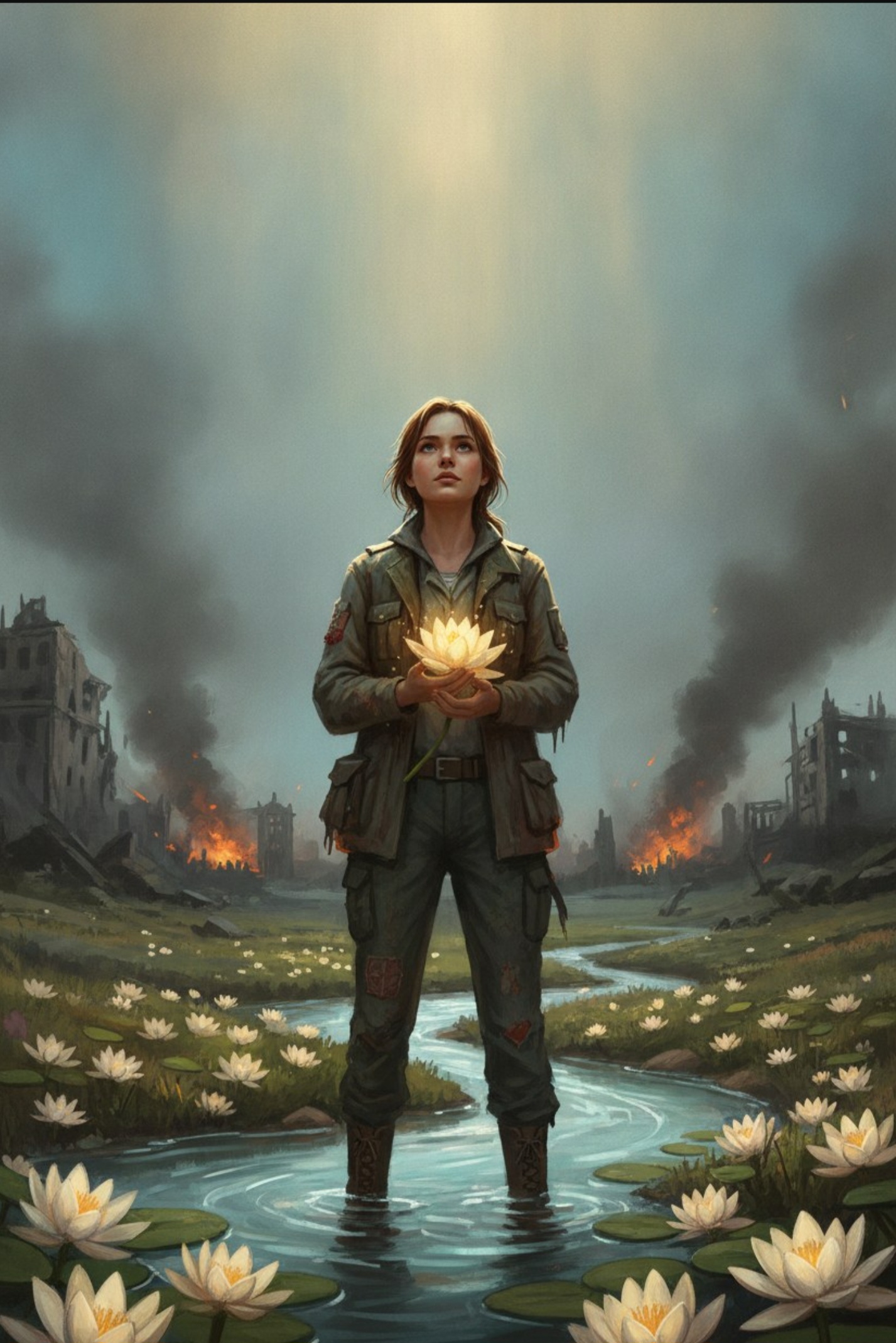
The girl grew up. Caring for her grandfather had become, it seemed, a little easier. But that was only how it seemed. In reality, her every movement was now timed to the second. Like a broken but stubborn mechanism. Pour water, straighten the blanket, wipe away the sweat. Wait again for him to open his eyes. And Grandpa Sanych hardly ever got up. His body seemed to be growing into the bed. Becoming part of the old house. Its creaks and shadows. Mama spoke quietly, almost in a whisper. Afraid the words would become a verdict: “He’s unlikely to live until spring.” And there was so much hopelessness in that whisper. Dina learned not to breathe when Mama spoke like that.
And so it happened. On one overcast autumn day the sky seemed to sink below the rooftops. Pressing down on the city with a damp, viscous weight. Grandpa called Dina over. His voice was like the rustle of dry leaves. Barely audible, but insistent, clinging to the last crumbs of strength.
“It’s hard for me. Hard to breathe. I want to give you some parting words. We live in difficult times, but you have a strong spirit. We’ve been through a lot—don’t give up. Keep going forward with your teeth gritted. Everything will be all right.”
Tears welled in Dina’s eyes, so hot they seemed to want to burn through her eyelids. She held back as best she could, clenching her fingers until her knuckles went white. Mama had taught her: you mustn’t show grief in front of the sick. It only makes them worse. But in that moment it seemed to Dina that if she cried, at least she might release this unbearable weight pressing on her chest.
“Grandpa, I love you very much. Please don’t think about bad things. You’ll live longer—I want that so much. Don’t leave us.”
He was breathing heavily. Each breath was like a struggle. Dina got up from the chair; her hands were shaking, but she forced herself to move. She opened the window, and cold wind burst into the room. It seemed to want to sweep out the very silence that was growing thicker. A gray dove landed on the windowsill and began to coo. The sound was absurdly ordinary. Almost mocking against the backdrop of what was happening in the room.
“Oh, it must be asking for food,” the girl thought. This simple, childish thought delayed the approaching darkness for a second. She ran to the kitchen for millet, her bare heels thudding on the floor. Clinging to this small, silly concern like a lifebuoy.
When she returned, the dove was gone. Dina turned to her grandfather, but… Grandpa was dead. His hand, still slightly bent. Probably it had wanted to grab something, lay on top of the blanket, and his fingers were icy. The cold had reached him before she returned.
The girl burst into sobs—and this time she didn’t try to hold back. Sobs tore from her chest, turning her inside out. In those tears was all her pain. All the injustice of a world that so easily took away those dearest to her. And Grandpa had been her consolation, her quiet harbor in these stormy times. They often sat up late, talking about trifles. Which suddenly became the most important things in the world. They supported each other when it seemed there was no strength left. But now he was gone. Life had been unfair to them—cruel and indifferent, like freezing rain lashing your face for no reason at all.
She ran to get Mama. Her legs gave way, and one thought hammered in her head: “If only I make it in time, if only someone says it’s a mistake.” The medical unit was not far from their home. But that day the road seemed endless. Every step echoed in her chest with a dull pain. The air was thick as tar, and it was almost impossible to draw it into her lungs.
At the cemetery Dina noticed it had grown larger since Papa’s funeral. The earth seemed to greedily swallow new graves. Expanding like a living, indifferent creature. Looking at the crosses and portraits of people smiling from the hills, she felt uneasy. Nauseously so, down to a cold chill in her belly. She felt especially sorry for the young and the children. They had still had so much life ahead of them, and yet they had died. Joyful in photographs, but dead in reality. Life is grass that has dried up and no longer grows. It only crumbles into dust underfoot.
In her diary Dina wrote again: “Grandpa Sanych is no more.” On the page there was an ink blot blurred by tears in the shape of a sun. It looked like a mockery. So bright, round, as if promising warmth that was no longer there. “Maybe it’s a good sign?” she thought, clinging to the idea like a straw. But she didn’t believe it herself. Who knows. Time will tell.
Days flew by in the turmoil of wartime, merging into one endless gray stream. A third portrait was hung by the icon corner, also tied with a black ribbon. That was the custom in the family—a black ribbon like the seal of loss. Like a mute sign that the world had changed forever. And every time Dina looked at those portraits, it seemed to her that the shadows of the dead were whispering something to her. Something she couldn’t make out, but that made her shudder.
Ninth grade was soon coming to an end. It was time to choose a profession. For Dina that question did not arise: she wanted to become a nurse, like Mama. To do that she had to go study in another city. The times were hard, but there were nursing courses. Medics were desperately needed in that period. That need seemed almost cruel. Life demanded new hands ready to hold someone else’s pain.
After finishing school, Dina enrolled in nursing courses. Mama stayed at home alone, and Dina had to move into the dormitory at the college. The room was cramped, with thin walls through which other people’s sighs and whispers could be heard. At night Dina lay looking at the ceiling and felt endlessly alone. Dina’s mother helped, sent a little money, because the stipend was too small to cover even the bare necessities. Dina found a side job as a cleaner at the hospital. She scrubbed floors, washed corridors, hauled buckets of water. Wiped dust from long-forgotten cabinets. She took any work and wasn’t afraid of labor. It helped her stay afloat. Sometimes, when fatigue bore down on her with all its weight, it seemed to her that she was simply trying not to drown in this cold, ruthless world. And every time she picked up a mop or a rag, she thought of her grandfather: “I’m moving forward with my teeth gritted. I won’t give up.”