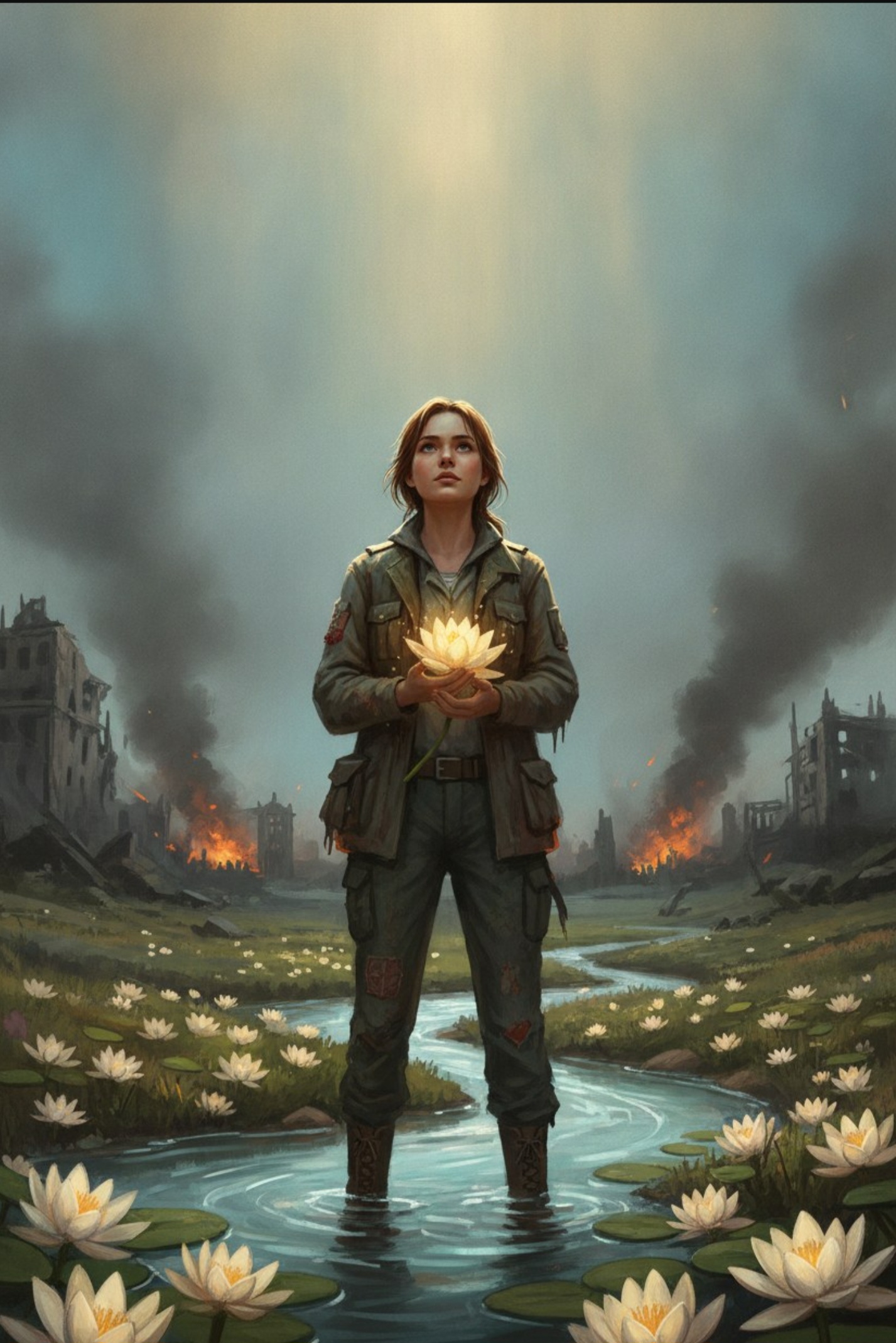
In the morning the frost had painted patterns on the windows. Thin, fragile lines, like cracks across the glass of her life. Thirteen-year-old Dina was waiting for her father, who had gone to buy goods. It was winter outside. At that time the country was going through hard times: crisis, war. The conflict clouded her family’s life, eating into their daily existence like frost that cannot be scraped away.
During a shelling, a shell hit the bus carrying her father, Ivan Petrovich. Help did not arrive in time. He died. In the evening the phone rang, and that call changed everything. The voice on the other end was dry, alien. As if it were speaking not to her but into the emptiness of the room. There, every object still held her dad’s smell.
The identification and the funeral passed as if in a fog. In that gray haze when the world becomes flat and soundless. The family suffered from grief, from losing their balance. From the loss of a beloved husband and father. The trials were only beginning. Now her mother, Anna, was raising two children alone. Dina and her younger brother Kostya. And on top of that, her mother’s father, Grandpa Sanych, was ill. To feed the family, her mother worked at the hospital as a nurse, two shifts. All the care fell on Dina’s shoulders. She grew up quickly. She cleaned, cooked, helped her brother, got him ready for school. Her diary reflected the pain of loss. The first entry: “Papa is gone…” — written in a trembling hand, and the ink had run, as if the pages themselves were crying.
The fighting did not stop. The country was divided, and it was hard for those on opposing sides of the conflict. Sirens wailed, volleys thundered. Dina was afraid to go outside. You might not come back, or you might come back to ruins. Every step along the snowy sidewalk felt like a test of endurance. The ground beneath her feet could crack open at any moment—literally.
Grandpa Sanych was growing weaker, but Anna, Dina’s mother, still managed to find the necessary medicines. Sometimes she had to walk across the entire city, bypassing dangerous neighborhoods. The goal was to get at least something to keep life in Grandpa Sanych’s old body. Approaching the mirror, Dina saw the weariness in her own eyes. The kind that does not go away even in sleep. But she did not give up. She did not allow herself to fall apart.
Spring flew by quickly, like a frightened bird that flashes past the window and vanishes at once. The time for plowing came. The family had a vegetable plot five kilometers away. In rain and heat they walked there. Their mother helped them plant and harvest. And everything else to do with tending the plot, she did together with her brother. The work was hard, but it brought them together. During those hours they could pretend they were just an ordinary family. That misfortune was somewhere far away, beyond the horizon.
Some neighbors were leaving; the conflict was escalating. Food and medicine shortages began. Water and electricity were often cut off. One day, returning from weeding, they wanted to wash and cook. But there was no water—it had been shut off. They had to go to the pump. “Let’s fetch some water, and go wash at the river?” she suggested to her brother.
Shelling of the Beach
Three hundred meters from the river, they heard the whistle of bullets and shouts. At first the sound was strange. Not like a shot, but like a sharp, angry shriek, as if the sky had been slashed with a knife. And right then something crashed nearby so hard that the ground jerked as if it were alive.
The beach was nearby, beyond a low embankment. The heat was incredible, and many children had gathered there that day. Some were splashing near the shore, some were building castles out of wet sand. Some were laughing, not knowing that laughter could break off at any second. Dina managed to notice a bright cap on one boy. Orange, like a glint of sun. At that very moment everything around exploded into motion.
A mortar shelling began. The first blast struck the slope. Clods of earth, stones, dry branches rained down. All of it flew like hail and hit painfully against shoulders and backs. The second explosion landed closer to the water. Sand flew up in a cloud, gray and thick as ash. The screams became louder than the thunder. That was the most terrifying part. There was no anger or strength in them, only pure, naked horror.
Dina grabbed Kostya by the hand. Her fingers dug into his palm so hard that her knuckles went white. They ran, stumbling over roots and potholes, not looking where they were going. The sand slid under their feet. It seemed the ground itself was pushing them away. Did not want to hold them. The whistling overhead was now everywhere. It circled like a hungry bird, looking for somewhere to sink its claws.
When they burst into the apartment and fell onto the sofa, they were shaking so hard that their teeth chattered. That chattering was the only sound they heard while the world outside kept thundering. Tears fell onto the fabric, leaving dark spots like little holes in reality. “When will all this end?” they thought. That day remained in their hearts for the rest of their lives. It seeped under the skin like soot. God spared their lives this time as well. Dina did not yet know whether to count that as mercy or as fate’s mockery.
The dead were called the “Angels of Donbass.” A memorial was erected in their memory in Donetsk. That stretch of history has not been forgotten to this day. It lived in every breath. In every glance that lingered on the empty place beside them.